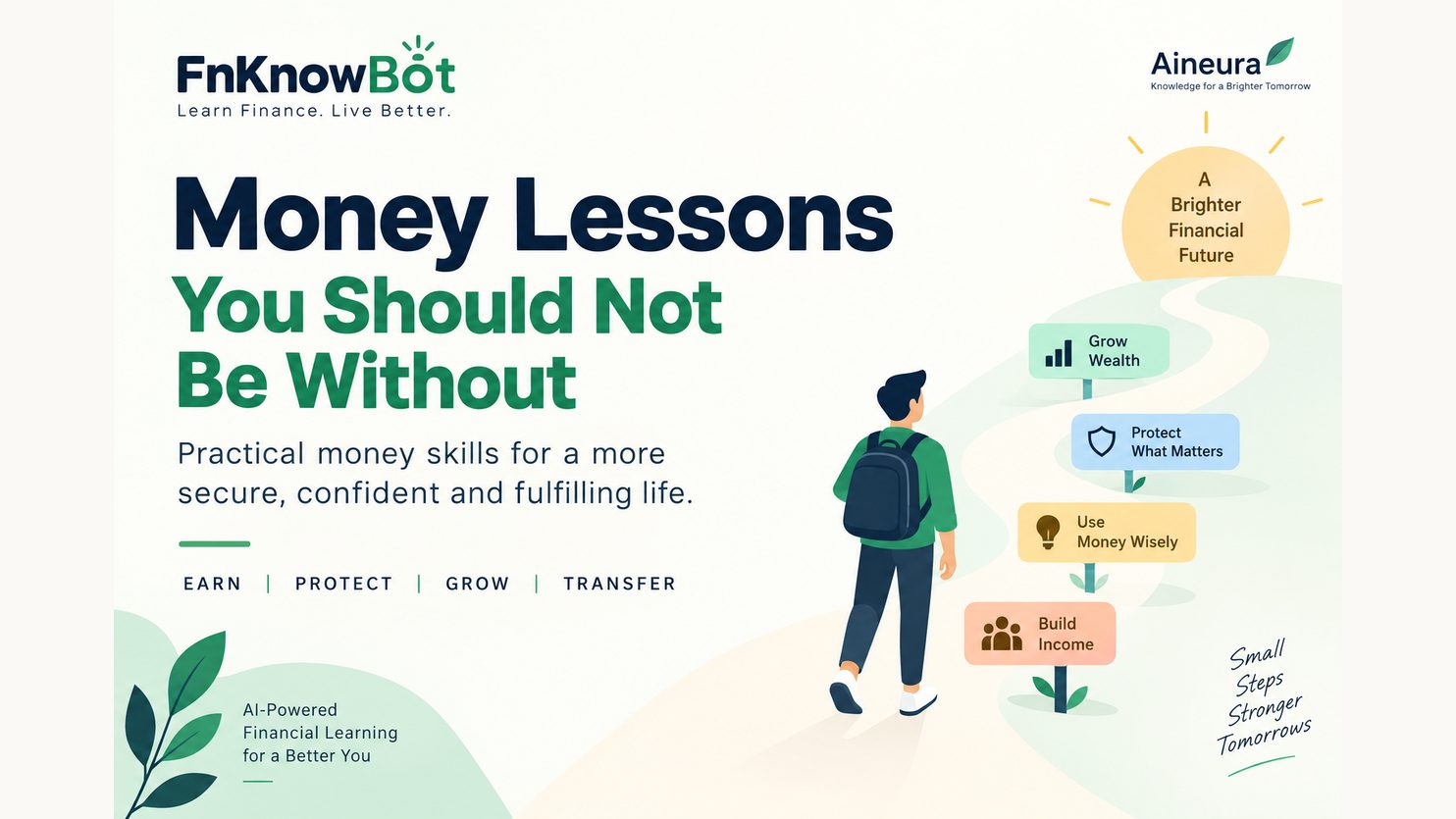
Earn. Protect. Grow. Transfer: The Money Skills Every Earning Individual Needs
We are taught how to study, work and earn—but rarely how to use money, protect it, grow it and ultimately pass it on wisely.
By: Amit R Charan , Founder, Aineura
Most of us are encouraged from an early age to study, obtain qualifications, find work and earn an income.
Yet one of the most universally required life skills is rarely taught with equal seriousness: what should we actually do with the money once we start earning it?
How do we generate income sustainably? How much should we save? How should we invest? What risks should we insure? How should we manage debt? What happens to our assets when we are no longer around?
These questions eventually confront almost every earning individual—and often their families too.
1. Build Sustainable Income Streams
The first priority is naturally income—but even here, the world is changing.
Individuals should continuously assess whether their present skills and income sources are likely to remain relevant over the coming years.
Alongside a primary occupation, it may be worthwhile exploring supplementary income streams that are scalable and do not require constant physical presence—digital products, technology-enabled services, intellectual property, online businesses or other models where automation and AI can improve efficiency.
The objective is not to chase every “passive income” trend, but to reduce dependence on a single source of earnings wherever realistically possible.
2. Learn to Invest—Not Merely Save
Income generation should gradually be accompanied by investing and long-term wealth creation.
Depending on financial goals, time horizon and risk profile, individuals can learn about instruments such as mutual funds, ETFs, bonds, REITs, equities and other asset classes.
Some investors may also choose limited exposure to higher-risk assets, but such decisions should be based on proper understanding rather than excitement or social-media trends.
The larger principle is diversification—building a balanced portfolio across suitable asset classes instead of depending excessively on a single investment.
3. Create a Real Emergency Fund
Unexpected events do not wait for convenient financial circumstances.
A practical starting objective is to maintain liquid contingency savings sufficient to cover approximately six months of essential expenses—rent or EMIs, utility bills, school fees, maintenance, medical costs and other unavoidable commitments.
Over time, individuals may work towards an even stronger contingency reserve depending on their income stability, family responsibilities and circumstances.
An emergency fund is not designed to maximise returns. Its principal purpose is financial resilience.
4. Protect Against Financial Leakage and Catastrophic Risks
Building wealth is important. Protecting it is equally important.
Individuals should understand which risks could significantly damage family finances and consider appropriate protection.
- Term-life insurance for income protection where appropriate;
- Health insurance for individuals and families;
- Motor insurance with suitable protection;
- Insurance for homes, shops, inventories and other valuable assets;
- Cyber-fraud or cyber-risk protection where relevant;
- Professional indemnity insurance for professionals and directors where appropriate;
- Portfolio-risk management rather than uncontrolled concentration in a single asset.
Insurance should be understood as risk protection—not simply as another investment product.
5. Manage Debt and Credit Before They Manage You
Credit can be useful when used responsibly. It can also become one of the biggest sources of financial stress when misunderstood.
Every earning individual should understand interest costs, credit-card billing, minimum-payment traps, loan tenure, EMI obligations, credit utilisation, credit scores, secured versus unsecured borrowing and the consequences of default.
Before taking debt, the question should not only be “Am I eligible?” but also “Can I comfortably afford this commitment?”
6. Plan Nomination and Succession Before It Becomes Urgent
People spend decades building assets but often give surprisingly little attention to what happens to those assets later.
Where available, nominations should be maintained and regularly reviewed for bank accounts, investments, insurance policies and other financial assets.
Individuals should also consider having a properly prepared Will and maintaining an organised record of important assets, liabilities and documents.
Families with businesses or more complex asset structures may additionally need to consider business succession, estate planning or structures such as private trusts with appropriate professional advice.
7. Budget, Journal, Plan Taxes—and Keep Learning
Good financial habits are often more powerful than occasional financial decisions.
Maintaining a budget, tracking major expenses, periodically reviewing investments and liabilities, and planning taxes can reveal financial leakage that otherwise remains unnoticed.
Individuals should also understand the broad tax, duty and compliance implications of important transactions rather than considering them only after a decision has been completed.
Tax and stamp-duty treatment can differ depending on the transaction, asset, relationship between parties and applicable jurisdiction, so material decisions should be checked with qualified professionals.
Most importantly, financial learning should continue throughout life. The better an individual understands finance, the better equipped they are to supervise advisers and professionals who manage or advise on their money.
8. Think Beyond Income Towards Long-Term Wealth Creation
Financial planning should not only focus on survival and protection. At some stage, individuals should also think about growth.
That may involve acquiring new skills, becoming future-ready, exploring entrepreneurship, expanding an existing business or carefully taking calculated risks towards a larger objective.
Meeting people from different industries, travelling, interacting with entrepreneurs and learning from people with different perspectives can also expand the way we think about opportunity and wealth creation.
Not everyone must become an entrepreneur. But everyone can benefit from developing an entrepreneurial mindset towards learning, adaptability and opportunity.
The Missing Life Skill: Learning Money
Financial knowledge is not a one-time subject.
Our financial needs change when we begin earning, get married, have children, buy a home, start a business, invest, retire or plan succession.
Yet formal education still often prepares people extensively for earning an income without giving equal attention to managing that income across an entire lifetime.
Making this learning understandable and accessible can contribute not only to better individual decisions, but also to financially stronger families, businesses and communities.
Where FnKnowBot Fits
At Aineura , we are building FnKnowBot as an AI-powered multilingual learning platform through which individuals can continuously explore these and many other areas of Personal Finance and Business Finance.
Learners can begin through guided questions, ask their own queries, seek follow-up explanations, create study notes, use quizzes and access video-supported learning—all at their own pace.
FnKnowBot supports 15+ Indian languages and major world languages, helping financial concepts reach people in a language they understand more comfortably.
The same platform can also be adopted by banks, financial institutions, corporates, educational institutions, NGOs, non-profits, foundations and other organisations seeking to make practical financial learning available to customers, employees, students, entrepreneurs, families and communities.
Towards Generational Financial Capability
When one individual becomes financially better informed, the benefit often does not stop with that person.
Financial habits and understanding influence spouses, children, parents, businesses and future generations.
Aineura is open to collaborating with corporates, financial institutions, educational institutions, NGOs, non-profits and other organisations seeking to use FnKnowBot to make practical financial learning more accessible and create deeper, sustainable social impact.
Explore FnKnowBot for AI-powered multilingual Personal Finance and Business Finance learning.
About the Author: Amit R Charan is the Founder of Aineura , an MSME-registered AI-EdTech startup working in the financial-literacy space. He is an entrepreneur, author and banking & finance lawyer with nearly two decades of professional experience.
About FnKnowBot: FnKnowBot is Aineura’s AI-powered multilingual learning platform covering Personal Finance and Business Finance for individuals, entrepreneurs, institutions and communities, with support for 15+ Indian languages and major world languages.