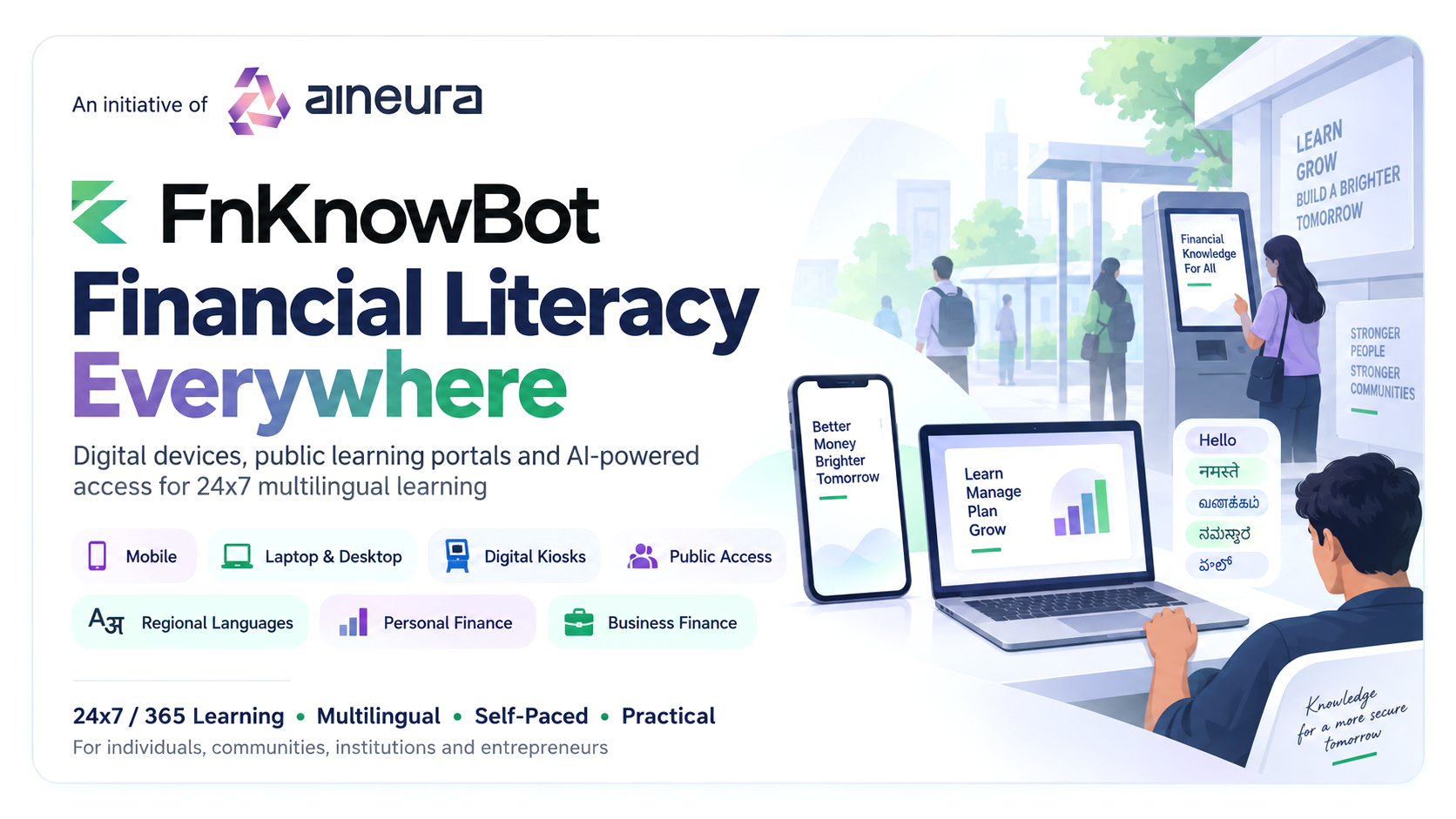
Financial Literacy Everywhere: Using Digital Devices and Public Infrastructure for 24x7 Learning
From mobiles and laptops to digital kiosks, smart-city touchpoints and public learning portals—taking multilingual financial learning closer to people.
By: Amit R Charan , Founder, Aineura
Financial literacy is usually associated with workshops, classrooms, awareness camps, websites or learning through personal devices.
But what if financial learning became available almost everywhere people already spend their time?
A mobile phone, tablet, laptop or desktop remains the most conventional access point. Yet internet-enabled digital kiosks, public learning terminals and smart-city infrastructure can potentially take financial education much further—into communities, libraries, transport hubs, malls, educational campuses and other public spaces.
Beyond Mobile, Tablet and Laptop Learning
Personal digital devices have made learning easier than ever. However, access to a smartphone or laptop does not necessarily mean that a person will actively search for financial education.
Financial learning can become more visible and approachable when it is also made available through shared public-access points such as:
- Digital kiosks and community learning centres;
- Libraries and educational campuses;
- Banking and financial-service locations;
- Municipal and government service centres;
- Rural and semi-urban digital access points;
- Public learning portals and shared tablets.
With internet connectivity and an intuitive learning interface, these devices can become continuously available gateways to financial knowledge.
Smart Cities Can Also Become Learning Cities
The idea can extend further.
Developers and administrators of smart cities can explore financial-learning access at locations where people naturally spend waiting or leisure time.
Imagine interactive financial-learning devices at selected:
- Bus stops and transport terminals;
- Metro and railway waiting areas;
- Public transport hubs;
- Malls and commercial public spaces;
- Libraries;
- Community centres;
- Other high-footfall public locations.
A person waiting ten minutes for transport might learn how a credit score works. Someone sitting in a library might explore retirement planning. A small-business owner could ask a question about working capital while visiting a community digital centre.
These may appear to be small interactions, but repeated access can gradually build meaningful financial capability.
Financial Learning Has to Become a Habit
One of the biggest challenges in financial literacy is behavioural: most people do not naturally sit down to study finance.
They often begin learning only when a financial decision is immediately in front of them—taking a loan, purchasing insurance, considering an investment, receiving a suspicious message or facing a business cash-flow issue.
This is why micro-learning can be particularly useful.
Instead of expecting a learner to complete a long course, financial education can be broken into short, practical interactions:
Five minutes today, another question next week and a short refresher when an actual financial decision arises can collectively build understanding over time.
Learning in the Language of the Region
Public-access financial education will have limited impact if the learner cannot comfortably understand the language being used.
Multilingual learning therefore becomes central to meaningful digital inclusion.
Through FnKnowBot , Aineura currently supports learning across 15+ Indian languages and major world languages.
A public-access device can therefore potentially offer a learner financial concepts and query resolution in the language relevant to that region or community.
This can help make learning more comfortable, inclusive and approachable for people who may otherwise hesitate to engage with formal financial terminology.
Self-Paced and Non-Judgmental Learning
People often hesitate to ask questions that they believe may sound too basic.
A conversational AI learning platform can offer a more private and non-judgmental environment in which a learner can ask:
- What exactly is an EMI?
- How does insurance work?
- Why is my credit score important?
- How should I create a monthly budget?
- How does compound interest work?
- What should I do if I receive a suspicious payment request?
The learner can proceed at their own pace, repeat a question, revisit a topic and continue without the fear of being judged.
Personal Finance and Business Finance in One Learning Ecosystem
Financial capability is relevant both to individuals and to entrepreneurs.
FnKnowBot’s Personal Finance learning can support understanding across budgeting, savings, loans, credit, insurance, investing, retirement, financial planning and fraud awareness.
Its Business Finance learning can help entrepreneurs and SME/MSME owners explore topics such as:
- Business banking relationships;
- Cash-flow management;
- Working capital;
- Business debt;
- Financial products;
- Taxation and compliance awareness;
- Government schemes;
- Business budgeting and financial planning.
Professional accountants, bankers, lawyers and advisers remain important. But business owners should also understand the financial fundamentals well enough to participate meaningfully in decisions affecting their enterprise.
That is true financial empowerment.
24x7/365 Financial Learning
One major advantage of digital learning is that financial education does not need to depend entirely on a trainer being available at the right moment.
An internet-enabled learning system can potentially remain accessible 24 hours a day, 365 days a year.
That matters because financial questions arise in real life—not according to a classroom timetable.
Through guided questions, conversational learning, chat history, study notes, quizzes and video support, learners can begin with a simple question and progressively build deeper understanding.
One Platform, Multiple Deployment Models
A financial-learning platform does not need to be restricted to a standalone website.
Depending on programme requirements, FnKnowBot can potentially be customised and integrated through:
- Mobile and tablet access;
- Desktop and laptop access;
- Digital kiosks;
- Community learning terminals;
- Institutional websites and portals;
- Mobile applications;
- Existing Learning Management Systems;
- Smart-city and public digital-learning infrastructure.
Learning modules, languages, user pathways and programme features can also be configured around the intended audience and implementation objective.
From Digital Inclusion to Meaningful Financial Inclusion
Digital inclusion should ultimately enable people to do something useful with digital access.
Financial learning is one such use.
A financially informed individual may be better equipped to understand borrowing, assess insurance, plan savings, recognise fraud and approach investment decisions more carefully.
A financially informed entrepreneur may be better equipped to understand cash flow, working capital, debt and financial planning rather than remaining entirely dependent on outsourced professionals for understanding the financial position of the business.
Over time, stronger financial capability can contribute to better household decisions, more resilient livelihoods, responsible entrepreneurship and more meaningful participation in the formal financial system.
Imagine Financial Learning Everywhere
Imagine a budgeting question answered while waiting for a bus.
A fraud-awareness lesson explored at a community kiosk.
A student learning about credit at a library.
An entrepreneur understanding working capital through a public digital-learning centre.
Individually, each interaction may be brief.
Collectively, they can help create a culture of continuous financial learning.
At Aineura , our vision through FnKnowBot is to explore how AI-powered multilingual Personal Finance and Business Finance learning can help institutions and communities turn digital access into practical knowledge—and practical knowledge into deeper, sustainable social impact.
About the Author: Amit R Charan is the Founder of Aineura , an MSME-registered AI-EdTech startup working in the financial-literacy space. He is an author and a banking & finance lawyer with nearly two decades of corporate legal experience.
About FnKnowBot: FnKnowBot is Aineura’s AI-powered multilingual learning platform covering Personal Finance and Business Finance for individuals, entrepreneurs, communities and institutions, with support for 15+ Indian languages and major world languages.