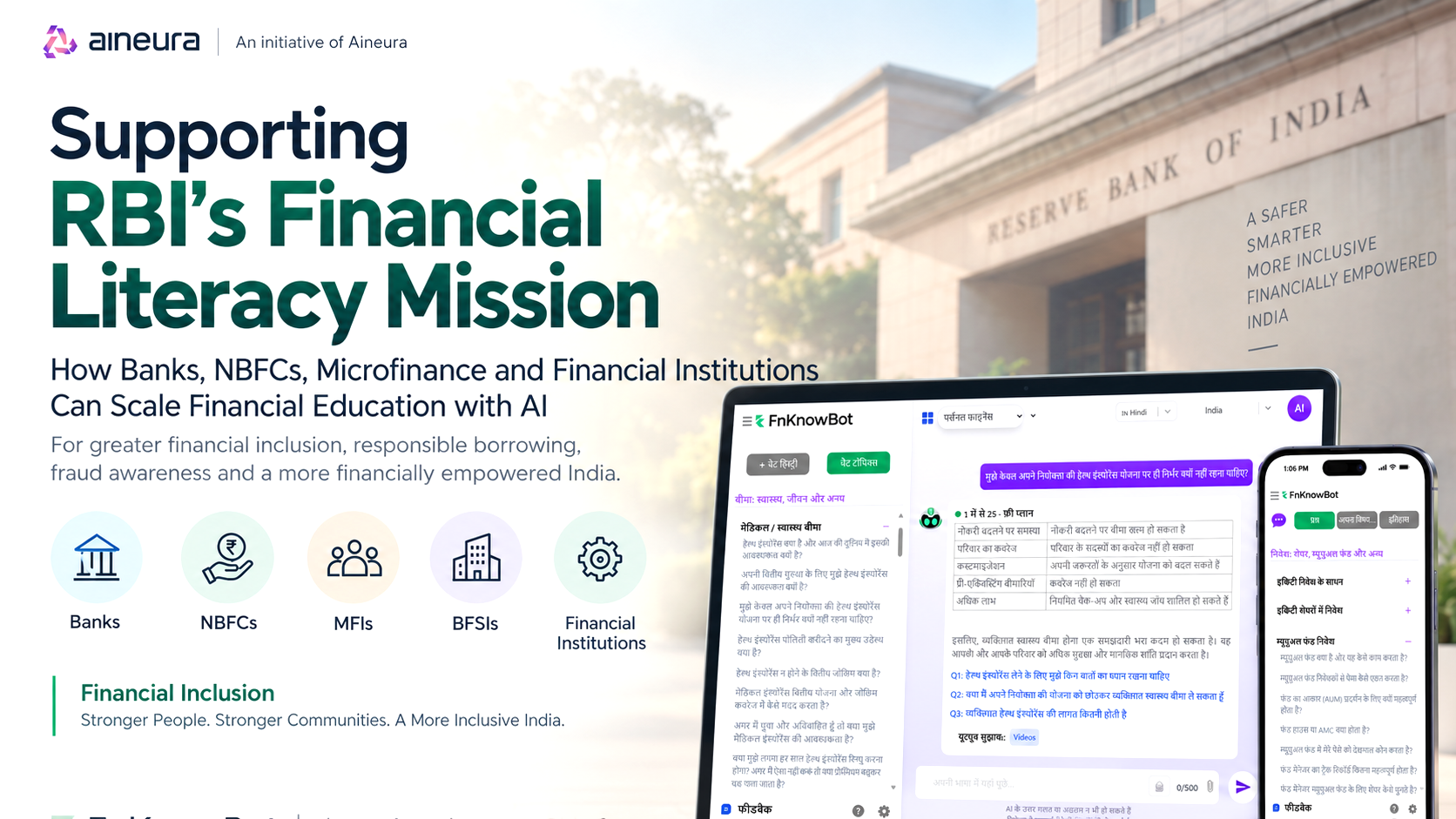
Supporting RBI’s Financial Literacy Mission: How Banks, NBFCs, Microfinance and Financial Institutions Can Scale Financial Education with AI
Moving from financial access towards informed customers, responsible borrowing, fraud awareness, digital inclusion and stronger financial capability.
By: Amit R Charan , Founder, Aineura
India has made remarkable progress in expanding access to banking, credit and digital financial services. The next challenge is equally important: helping people understand how to use those services safely, responsibly and productively.
The Reserve Bank of India has consistently placed financial literacy alongside financial inclusion through initiatives involving banks, Financial Literacy Centres (FLCs), Centres for Financial Literacy (CFLs), awareness campaigns and customer-education programmes.
RBI’s Annual Report 2024-25 records that the CFL network had expanded to 2,421 centres across the country by March 2025. It also reported 1,508 FLCs conducting more than 1.31 lakh financial-literacy camps during April–December 2024.
The opportunity now is to complement this physical infrastructure with technology that can make financial learning available continuously, interactively and in the learner’s preferred language.
Financial Inclusion Must Also Mean Financial Understanding
Opening an account, obtaining a loan, purchasing insurance or adopting digital payments represents access to finance. But meaningful financial inclusion requires something further—understanding.
Customers should be able to understand basic concepts relating to:
- Savings and budgeting;
- Loans, EMIs and interest costs;
- Credit cards and credit scores;
- Insurance and financial protection;
- Investments and diversification;
- Retirement and long-term financial planning;
- Digital payments and safe banking practices;
- Financial frauds and consumer protection.
Responsible Borrowing for Banks, NBFCs and Microfinance Customers
Banks, NBFCs and microfinance institutions play an important role in extending formal credit to households, entrepreneurs, small businesses and underserved communities.
Alongside credit access, borrowers can benefit from understanding repayment capacity, effective borrowing costs, loan tenure, EMIs, secured and unsecured debt, credit scores, delayed-payment consequences and the risks of excessive indebtedness.
For microfinance borrowers and first-time users of formal credit, simple and local-language explanations can be particularly valuable in understanding commitments before taking a financial decision.
An informed borrower is not necessarily a borrower who avoids credit. It is a borrower who understands how to use credit more responsibly.
Financial Fraud Awareness Is Now Essential Financial Literacy
As financial services increasingly move online, financial literacy must also include digital safety.
RBI has continued awareness initiatives relating to safe banking practices and financial frauds, including campaigns addressing emerging forms of digital deception.
Customers should understand common risks relating to:
- OTP, PIN and password sharing;
- Phishing and fraudulent links;
- Fake loan and investment offers;
- Impersonation and digital-arrest scams;
- Suspicious payment requests;
- Safe use of digital banking and payment channels.
Fraud awareness should therefore become part of continuing financial education rather than remaining only an occasional warning after a fraud trend emerges.
SME and MSME Financial Literacy
Financial education is equally important for entrepreneurs and SME/MSME borrowers.
They require not only personal-finance awareness, but also practical understanding of Business Finance, including:
- Banking relationships and business borrowing;
- Cash-flow management;
- Working capital;
- Debt servicing and financial discipline;
- Financial products and business insurance;
- Taxation and compliance awareness;
- Government schemes and financing opportunities;
- Business budgeting and financial planning.
For banks and financial institutions, this creates an opportunity to combine customer education with entrepreneurial upskilling and livelihood support.
Can AI Help Scale the Financial Literacy Mission?
Physical camps, counsellors, branch-level programmes and community initiatives remain important. AI can complement them by giving learners access to financial education even after a programme or workshop ends.
At Aineura , we have developed FnKnowBot —an AI-powered multilingual learning platform covering both Personal Finance and Business Finance.
FnKnowBot enables learners to use pre-built guided questions, conversational AI, follow-up queries, study notes, quizzes and video-supported learning to understand financial concepts at their own pace.
With support for 15+ Indian languages and major world languages, it can help reduce one of the biggest practical barriers to financial education: language.
One Learning Platform, Multiple Financial-Inclusion Use Cases
Banks, NBFCs, microfinance institutions and other financial institutions can potentially deploy a platform such as FnKnowBot for different customer segments:
- Retail customers — personal finance and responsible financial decision-making;
- Borrowers — loans, debt management and credit awareness;
- Microfinance customers — basic finance, responsible borrowing and livelihood-related learning;
- SME/MSME customers — Personal Finance + Business Finance;
- Women and SHGs — savings, credit, budgeting and financial empowerment;
- Rural and underserved communities — multilingual financial and digital literacy;
- Senior citizens and families — fraud awareness, savings, insurance and retirement-related learning.
The platform can be customised for institutional requirements and integrated with existing websites, mobile applications, portals or assisted-learning programmes.
From Financial Literacy Campaigns to Continuous Learning
A financial-literacy camp can introduce an important concept. But a customer may have the real question several days later—when applying for a loan, receiving a suspicious message, considering an insurance policy or managing a cash-flow problem.
That is where conversational AI can add another layer to existing financial-literacy initiatives.
Institutional deployments can also support appropriate aggregated monitoring of programme reach, language preferences, learning engagement, topics explored and assessment indicators—helping institutions understand where additional education may be required.
Supporting the Larger Financial Literacy Mission
RBI’s continuing focus on financial literacy presents an opportunity for banks, NBFCs, microfinance institutions and other financial institutions to move beyond financial access towards deeper financial capability.
Technology can help institutions make financial education more accessible, multilingual, interactive and continuous—while existing human-led programmes continue to provide community engagement, trust and guidance.
For Aineura, this is where FnKnowBot can contribute: as a scalable technology layer supporting financial literacy, responsible borrowing, fraud awareness, SME/MSME capability, digital inclusion and sustainable social impact.
Explore AI-powered multilingual Personal Finance and Business Finance learning with FnKnowBot .
Note: Aineura and FnKnowBot are independent of the Reserve Bank of India. References to RBI initiatives are intended to discuss how technology-enabled financial learning can support the broader objectives of financial literacy and financial inclusion and do not imply any affiliation, approval or endorsement by RBI.
About the Author: Amit R Charan is the Founder of Aineura , an MSME-registered AI-EdTech startup working in the financial-literacy space. He is an author and a banking & finance lawyer with nearly two decades of corporate legal experience.
About FnKnowBot: FnKnowBot is Aineura’s AI-powered multilingual learning platform covering Personal Finance and Business Finance for individuals, entrepreneurs, communities and institutions, with support for 15+ Indian languages and major world languages.