Amit R Charan
Microfinance Needs More Than Credit: Financial Literacy Must Travel with the Loan
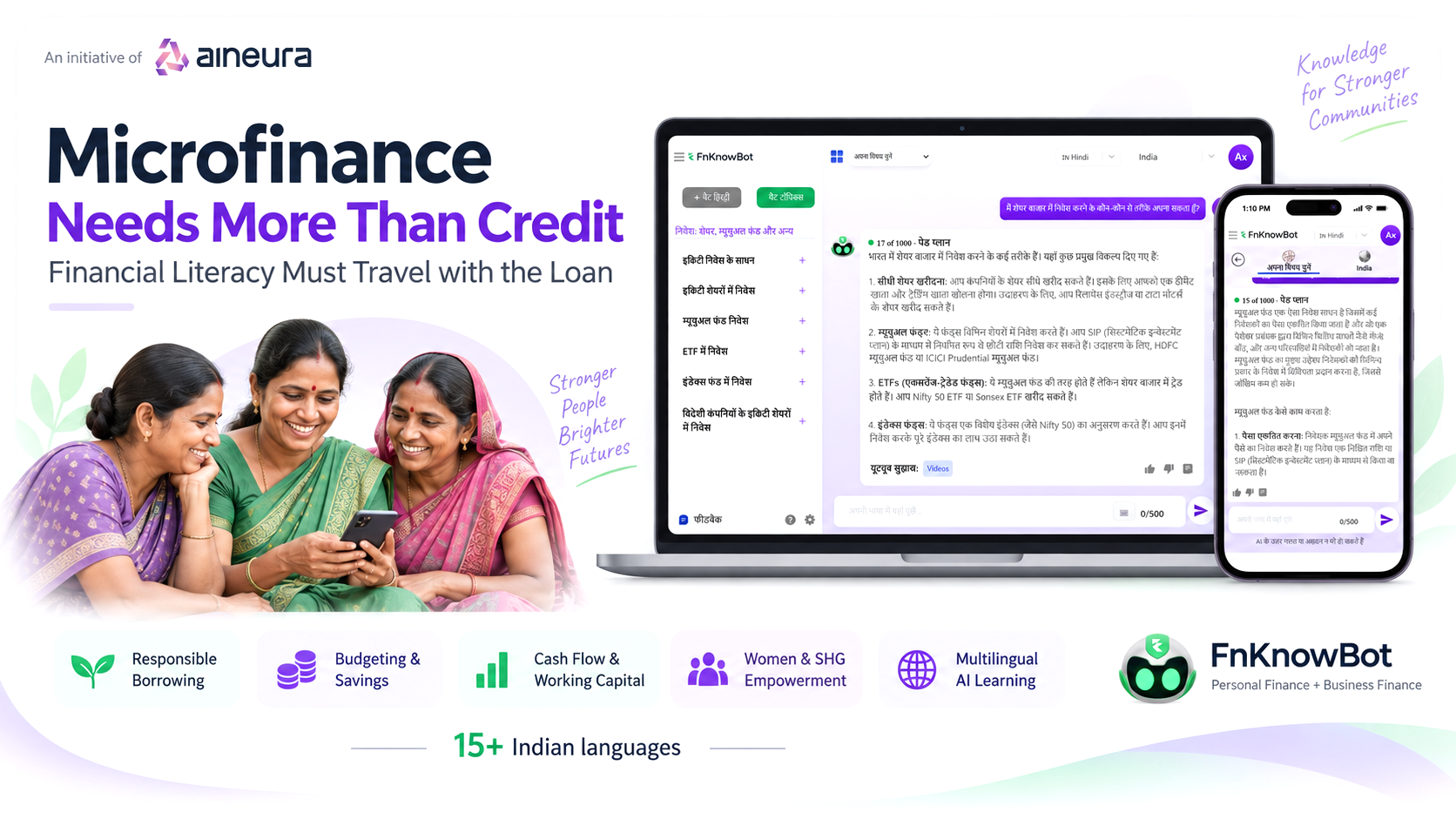
Microfinance Needs More Than Credit: Financial Literacy Must Travel with the Loan
Why informed borrowers, stronger financial capability and multilingual learning can deepen the impact of microfinance.
By: Amit R Charan , Founder, Aineura
Microfinance has played an important role in extending formal credit to individuals, women, self-help groups, micro-entrepreneurs and underserved communities.
But access to credit by itself does not always create financial capability.
A borrower may receive a loan without fully understanding repayment capacity, interest obligations, cash-flow pressures, credit discipline or the risks of taking multiple loans.
This is why financial literacy should travel alongside microfinance.
A Loan Is Only One Part of the Financial Journey
For many microfinance borrowers, financial decisions extend well beyond the loan itself.
A borrower may need to understand:
- Principal, interest, instalments and total repayment obligation;
- Repayment capacity and responsible borrowing;
- Household budgeting and emergency savings;
- The risks of over-borrowing or multiple loans;
- Credit history and repayment discipline;
- Digital payments and financial-fraud awareness;
- Insurance, pensions and other formal financial products.
Without this broader understanding, access to credit may solve one immediate need while creating new financial pressures later.
Micro-Entrepreneurs Need Business Finance Learning Too
Many microfinance borrowers are not merely consumers of credit. They are also running shops, home businesses, farms, service activities or small enterprises.
For them, personal finance and business finance are often closely connected.
Financial learning should therefore include practical concepts such as:
- Separating household and business money;
- Cash-flow management and matching repayments with income cycles;
- Working capital and day-to-day liquidity needs;
- Pricing, costs and margins;
- Business debt and repayment planning;
- Banking relationships and formal financial products;
- Basic taxation, compliance and record keeping;
- Government schemes and available support programmes.
A financially informed micro-entrepreneur may be better positioned to use borrowed capital prudently, recognise financial stress early and make more disciplined business decisions.
Women, SHGs and the Possibility of Wider Household Impact
Microfinance is also closely associated with women-led self-help groups and livelihood programmes.
Financial learning in such programmes can have an impact beyond the individual borrower.
A woman who better understands savings, borrowing, insurance, budgeting and business cash flow may carry that knowledge into household decisions and share it with other members of her group or family.
This is where financial literacy can begin contributing to deeper empowerment and potentially generational change.
Language Should Not Become a Financial Barrier
One challenge in financial education is that formal financial terminology may not always be easy for first-time borrowers or people more comfortable learning in a local language.
Financial literacy becomes more inclusive when borrowers can understand concepts in a language that feels natural to them.
Through FnKnowBot , Aineura supports financial learning across 15+ Indian languages and major world languages.
This can help banks, NBFC-MFIs, microfinance institutions, NGOs and community programmes take financial learning deeper into rural, semi-urban and underserved communities.
How AI Can Extend Financial Learning Beyond the Field Session
Microfinance programmes often depend on field teams, community meetings, workshops and group-based interactions.
These remain important because human trust and local understanding cannot simply be replaced by technology.
AI can, however, complement these efforts by providing:
- Pre-built questions for first-time learners;
- Simple explanations of financial concepts;
- Follow-up questions and instant clarification;
- Multilingual learning;
- Self-paced access beyond scheduled meetings;
- Study notes, quizzes and video-supported learning.
A field facilitator can introduce the subject. The learner can then continue independently or with assisted access through a shared device, community centre or digital kiosk.
Where FnKnowBot Can Fit
FnKnowBot combines Personal Finance and Business Finance within one AI-powered multilingual learning platform.
This makes it relevant for:
- Banks and Small Finance Banks;
- NBFC-MFIs and Microfinance Institutions;
- Self-help group programmes;
- NGOs and non-profits;
- CSR-led livelihood and inclusion initiatives;
- Foundations and development organisations;
- Government and community-based programmes.
The platform can complement existing programmes rather than requiring institutions to replace their current delivery model.
From Microcredit to Financial Capability
The success of microfinance should not be viewed only through the amount of credit disbursed or the number of borrowers reached.
A deeper measure of impact is whether borrowers become more financially aware, better able to manage obligations and more capable of making informed decisions for their households and enterprises.
That is where microfinance and financial literacy can work together towards deeper financial inclusion, livelihood development and sustainable social impact.
Explore AI-powered Personal Finance and Business Finance learning with FnKnowBot .
About Amit R Charan: Amit R Charan is the Founder & Director of Aineura, an author and a banking & finance lawyer with nearly two decades of corporate legal experience. His work and interests span finance, financial markets, technology, AI, entrepreneurship and financial education.
About Aineura: Aineura is an MSME-registered EdTech startup working in the financial-literacy space by leveraging artificial intelligence to make practical financial learning more accessible, multilingual, inclusive and scalable.
About FnKnowBot: FnKnowBot is Aineura’s AI-powered multilingual learning platform covering Personal Finance and Business Finance through guided questions, conversational learning, follow-ups, study notes, quizzes and video support across 15+ Indian languages and major world languages.