Small Lessons, Better Money Decisions: Why Microlearning Works for Financial Literacy
Financial education does not always need another long course. Sometimes people simply need the right concept explained clearly—at the moment they need it.
By: Amit R Charan , Founder, Aineura
Personal finance is a vast subject.
A person can spend years learning about budgeting, banking, loans, credit cards, insurance, investments, taxation, retirement planning, financial fraud and numerous other money-related subjects.
But most people do not wake up one morning wanting to study the entire world of finance.
They usually have a much smaller and more immediate question:
- Should I prepay my home loan?
- What does a credit score actually mean?
- What is the difference between term insurance and an investment-linked policy?
- How should I start budgeting my salary?
- What is diversification?
- How does compound interest work?
This is where microlearning can make financial education far more approachable.
What Is Microlearning?
Microlearning breaks a large subject into smaller, focused learning interactions that can be understood independently and revisited when required.
Instead of asking a learner to complete a lengthy financial-literacy course before receiving an answer, microlearning allows the person to begin with one relevant concept.
Over time, these small learning interactions can gradually build a much wider understanding of personal finance.
Why Finance Is Particularly Suited to Microlearning
Financial learning is closely connected to real-life events.
People become interested in a financial subject when they receive their first salary, apply for a loan, purchase insurance, begin investing, receive a credit-card bill, start a business or approach retirement.
At that moment, relevance is already present.
The learning challenge is to provide information that is:
- Easy to find;
- Simple enough to understand;
- Focused on the immediate question;
- Available when the learner needs it;
- Capable of leading naturally to deeper learning.
Microlearning therefore turns financial education into something that can happen alongside everyday financial life rather than only inside a classroom.
From Microlearning to Conversational Learning
Traditional microlearning often takes the form of a short video, flash card, infographic or small lesson.
Conversational AI can take the concept further.
A learner does not have to stop after receiving the first explanation. The next question may naturally follow:
“What does that mean?” → “Can you give me an example?” → “What are the risks?” → “How is this different from the other option?”
The learning journey becomes interactive rather than linear.
This is particularly useful in finance because one answer often creates the need for another question.
How FnKnowBot Supports Financial Microlearning
At Aineura , we have been building FnKnowBot around this very idea of making financial learning easier to begin and easier to continue.
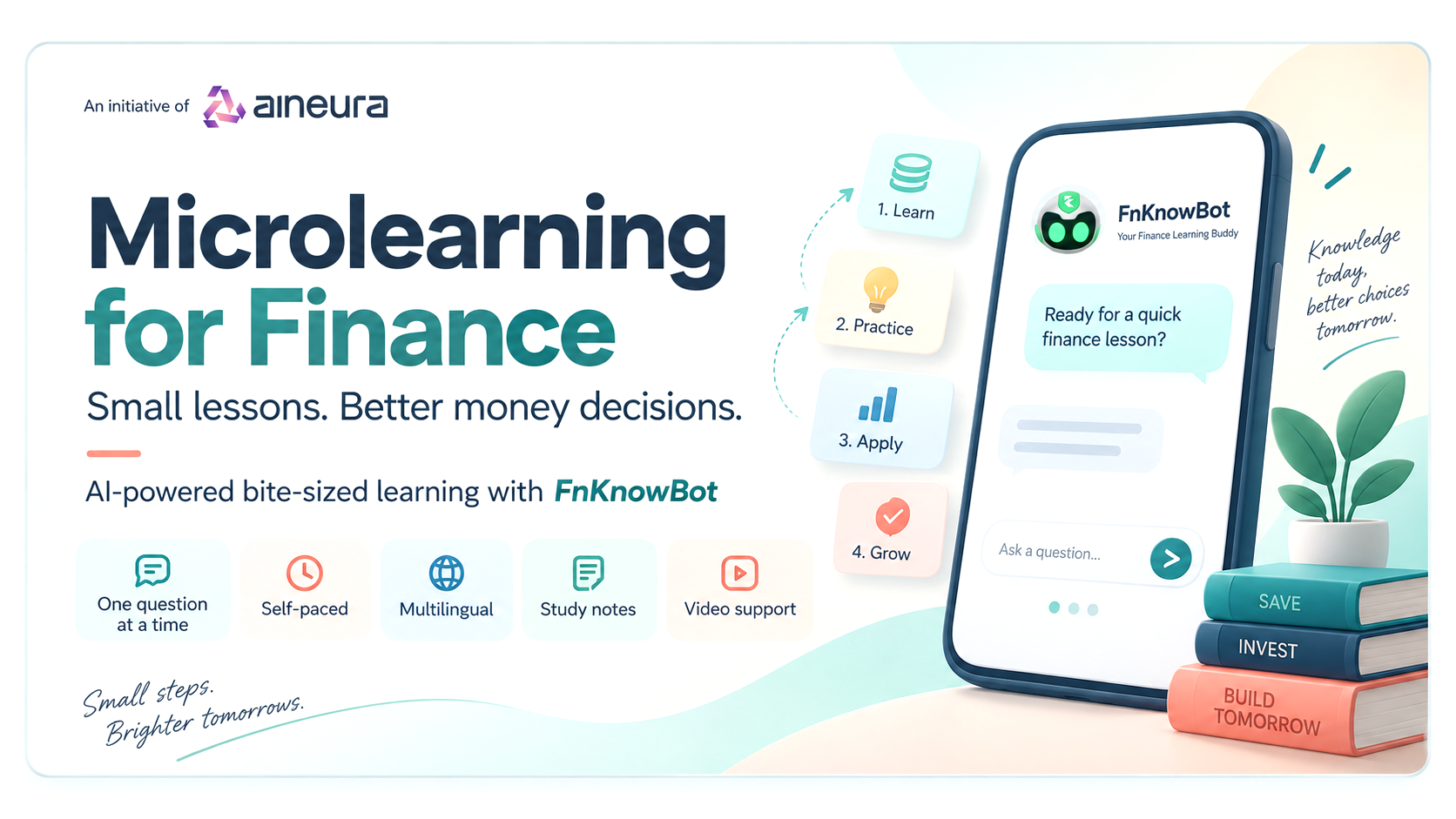
FnKnowBot combines several elements that naturally support microlearning:
- Pre-built questions help learners start without having to formulate the perfect prompt;
- AI-powered explanations address one financial question at a time;
- Follow-up questions allow learners to progressively deepen their understanding;
- Study notes and summaries help retain and revisit learning;
- Quizzes can reinforce understanding;
- Text and video learning provide different ways to explore concepts;
- Self-paced access allows learning whenever a need arises.
The objective is not to compress an entire financial subject into a few sentences. It is to make the entry point into learning smaller and easier.
Microlearning in the Learner's Own Language
A short explanation is useful only if the learner can comfortably understand it.
FnKnowBot supports 15+ Indian languages and major world languages, enabling learners to explore financial concepts in a language that may feel more natural to them.
This combination of small learning interactions + conversational AI + multilingual access can be particularly relevant for first-time learners, students, families, employees, entrepreneurs and communities that may otherwise find conventional financial education difficult to approach.
Microlearning for Business Finance Too
The same approach can support entrepreneurs, startups and SME/MSME businesses.
A business owner may not need an entire finance programme when trying to understand one immediate issue such as:
- Working capital;
- Cash-flow management;
- Business debt;
- Banking relationships;
- Financial statements;
- Taxation and compliance;
- Government schemes;
- Business financial planning.
Microlearning allows the entrepreneur to begin with the immediate problem and progressively build broader business-finance knowledge.
A Useful Model for Institutions
Microlearning can also make financial-literacy programmes easier for institutions to integrate into everyday engagement.
Banks and financial institutions can provide customers with learning relevant to the financial decisions they are making. Corporates can support employee financial well-being. Educational institutions can introduce students to practical money concepts. NGOs and non-profits can extend financial learning to communities.
Instead of expecting everyone to complete the same long programme, learners can enter at different points and continue according to their needs.
That makes financial learning potentially more flexible, scalable and inclusive.
Small Learning Can Build Bigger Capability
Microlearning should not mean superficial learning.
Its strength lies in making a complex subject easier to enter, allowing learners to build understanding progressively through many small but connected interactions.
That is the kind of learning experience we are working towards with FnKnowBot—helping people learn finance one question, one concept and one better-informed decision at a time.
Explore AI-powered, multilingual and self-paced financial learning with FnKnowBot .
About Amit R Charan: Amit R Charan is the Founder & Director of Aineura, an author and a banking & finance lawyer with nearly two decades of corporate legal experience. His work and interests span finance, financial markets, technology, AI, entrepreneurship and financial education.
About Aineura: Aineura is an MSME-registered EdTech startup working in the financial-literacy space by leveraging artificial intelligence to make practical financial learning more accessible, multilingual, inclusive and scalable.
About FnKnowBot: FnKnowBot is Aineura’s AI-powered multilingual learning platform covering Personal Finance and Business Finance through guided questions, conversational learning, follow-ups, study notes, quizzes and video support across 15+ Indian languages and major world languages.