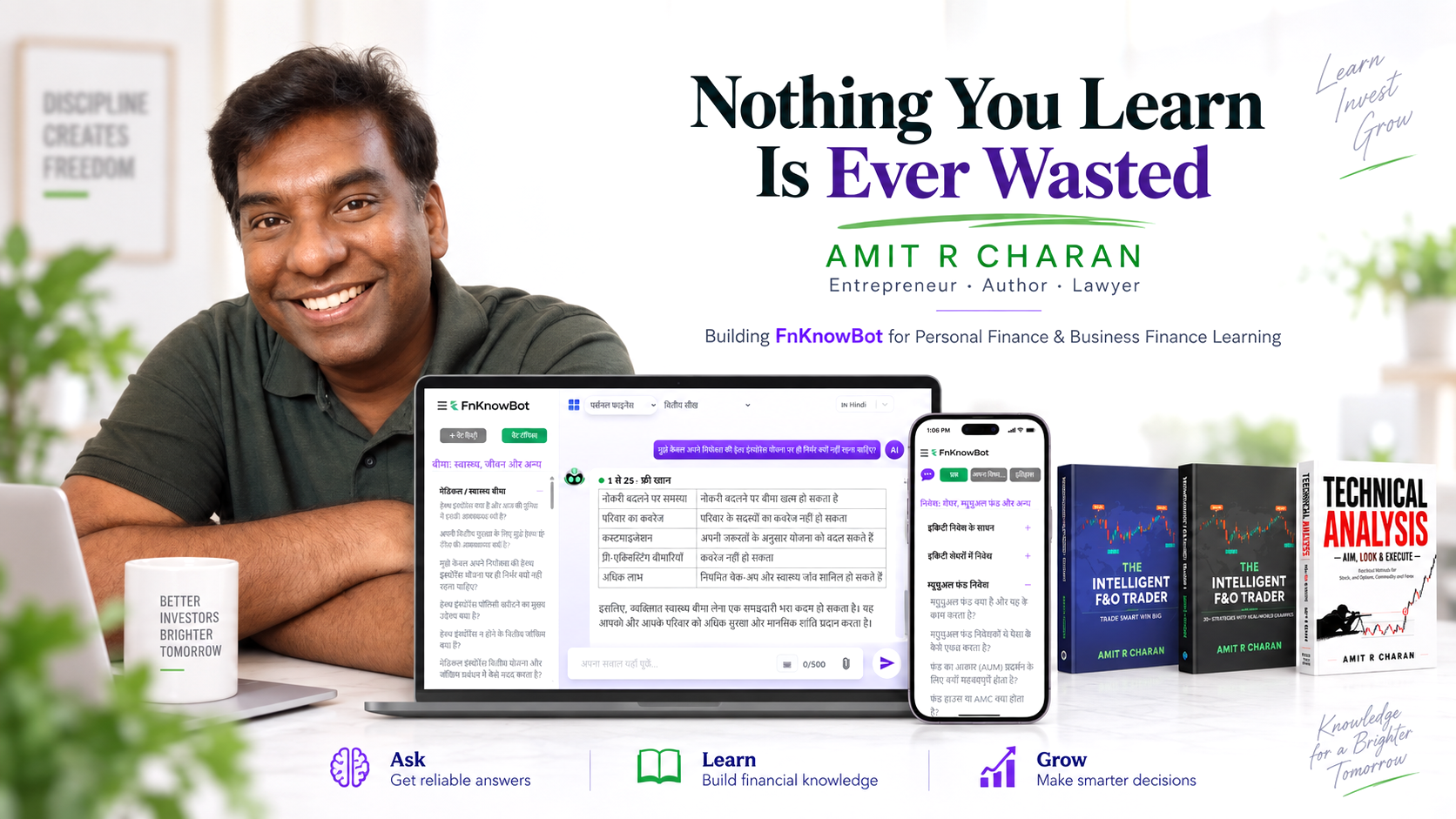
Nothing You Learn Is Ever Wasted
How different skills, studies and professional experiences eventually come together when you build a startup.
By: Amit R Charan , Founder, Aineura
One of the strongest lessons entrepreneurship has reinforced for me is this: nothing you genuinely learn is ever wasted.
A subject studied years ago, a skill developed through difficult professional assignments, a technical interest pursued out of curiosity, or even the ability to write, analyse and present ideas clearly may appear unrelated at the time.
Then you start building a company—and suddenly those different pieces begin finding their place.
A Founder Cannot Outsource Understanding
An early-stage entrepreneur rarely has the luxury of building a large workforce consisting of specialists for every function.
Even when specialists are available, someone still has to supervise, question, guide and ensure that the different parts of the organisation are moving in the right direction.
Your Chartered Accountant may prepare financial statements. Your Company Secretary may handle corporate compliances. Lawyers may prepare documentation. Developers may build the technology. Marketing professionals may execute campaigns.
But the founder has to connect these pieces to the larger business objective.
Financial Understanding Is Not Optional
An entrepreneur cannot completely outsource understanding of the numbers.
Revenue, expenses, cash flow, liabilities, working capital, financial ratios, projections, capital requirements and profitability are not merely accounting subjects. They influence strategic decisions every day.
The same applies when raising capital. Understanding financial modelling, valuation, dilution, projections and the kind of investment appropriate for the business allows a founder to participate intelligently in discussions with investors.
My MBA studies helped considerably in developing this understanding of financial statements, estimations, valuations, business modelling and financial modelling.
Professional advisers remain important. Founder understanding simply makes their advice more useful.
Legal Experience Helps Protect What You Build
Startups encounter legal issues almost everywhere—from incorporation, contracts and intellectual property to financing, employment, technology arrangements and institutional partnerships.
My own background of nearly two decades as a corporate lawyer, particularly in banking and finance, has been immensely useful while building Aineura.
It has helped me examine documentation, understand transactional risks, supervise compliances, structure commercial relationships and determine when something can reasonably be handled internally and when specialist assistance is necessary.
Legal understanding does not merely help control professional costs. More importantly, it can help identify issues before they become expensive problems.
Governance Experience Shapes Founder Decisions Too
My professional preparation in corporate governance for Independent Director roles has added another dimension to the way I approach entrepreneurship.
Governance is not relevant only when you sit on somebody else’s board. The same principles become equally important when you are governing your own startup.
It brings discipline to board-level thinking—looking beyond an immediate business opportunity to questions of risk, compliance, accountability, conflicts, stakeholder interests, financial prudence and the long-term consequences of important decisions.
I try to bring the same governance acumen into Aineura’s own board decisions. It helps me look at significant matters not merely as a promoter seeking growth, but also through the lens of responsible governance, documentation, oversight and long-term sustainability.
Understanding Technology Helps You Direct Technology
A technology founder does not necessarily have to personally write every line of code.
But understanding the technology stack, how systems interact and how advances in artificial intelligence can affect your product gives a founder far greater ability to guide development.
My programming studies, combined with a natural and continuing interest in technology and AI, have helped me communicate more effectively with developers, understand the technology behind FnKnowBot and evaluate which advances can meaningfully improve the platform.
Technology is changing rapidly. A founder must constantly distinguish between what is fashionable and what genuinely adds value to the user.
Writing and Financial-Market Experience Shaped the Product Too
My work as an author has contributed to the entrepreneurial journey in ways I had not necessarily anticipated.
Writing a book forces you to organise complex subjects, identify where a learner is likely to struggle and explain difficult ideas in a structured and practical way.
My books on financial markets—including Aim, Lock & Execute – Technical Analysis and The Intelligent F&O Trader series—required me to examine investing, trading, risk, market behaviour and decision-making through the eyes of a learner.
That experience became directly useful while shaping FnKnowBot’s Personal Finance learning—particularly in recognising common problem areas and thinking about how complicated financial concepts can be made simplified, practical and easier to explore.
Professional Experience Builds Skills No Classroom Can Fully Teach
There are also skills that come only through years of actually working.
Long professional hours teach endurance. Complex transactions teach precision. Presentations teach communication. Negotiations teach how to understand different interests. Working with organisations teaches how institutions think, evaluate risk and make decisions.
These experiences now help me supervise development, control expenditure, explore market fit, evaluate go-to-market strategies, meet potential partners, approach investors and continually question whether the startup is heading in the right direction.
Eventually, the Skills Begin to Connect
Law helped with structure and risk.
Governance brought discipline to board-level decisions and accountability.
Finance helped me understand the business and also the very subject around which our product is being built.
Management education helped connect strategy with numbers. Technology helped me work more closely with the product and development team. Writing helped translate complicated subjects into structured learning.
Individually, these were different experiences.
As an entrepreneur, they began fitting together.
How These Skills Came Together at Aineura
At Aineura , we are building FnKnowBot as an AI-powered multilingual learning platform covering both Personal Finance and Business Finance.
Personal Finance spans areas such as budgeting, savings, loans, credit cards, insurance, investments, retirement planning, debt management and financial-fraud awareness.
Business Finance extends the learning journey to entrepreneurs, startups and SME/MSME businesses across areas such as banking relationships, debt, cash flow, working capital, financial planning, taxation, compliances, government schemes and business financing.
By God’s grace, Aineura is increasingly discovering natural synergies in B2B institutional collaboration—with BFSIs, corporates, educational institutions, NGOs and non-profits that can use FnKnowBot to take financial learning to customers, employees, students, entrepreneurs and communities.
With support for 15+ Indian languages and major world languages, the platform also has the potential to progressively extend this learning experience to institutions and communities across geographies.
Keep Learning—Your Future Business May Need It
Being an entrepreneur—and particularly the founder of an early-stage startup—is certainly not easy.
You build, supervise, analyse, control costs, guide teams, understand customers, explore partnerships, evaluate technology, examine risks and continuously search for the right product-market fit and go-to-market strategy.
There will always be areas where you need people who know more than you. That is precisely why good teams, professionals and advisers matter.
But the more genuine skills and understanding you carry with you, the better equipped you may be to recognise what matters, ask the right questions and steer the organisation with confidence.
And when entrepreneurship is truly your calling, those seemingly unrelated skills, experiences and lessons can begin fitting together—piece by piece—into the larger picture.
A startup is never a finished picture.
It is a story in the making.
About Amit R Charan: Amit R Charan is the Founder & Director of Aineura, an entrepreneur, author and banking & finance lawyer with nearly two decades of corporate legal experience. His experience spans law, banking and finance, corporate governance, financial markets, management, technology and entrepreneurship. He is professionally equipped for Independent Director roles and brings the same governance discipline, financial prudence, risk awareness and board-level perspective to Aineura’s own strategic decisions. He is the author of Aim, Lock & Execute – Technical Analysis and The Intelligent F&O Trader series.
About Aineura: Aineura is an MSME-registered EdTech startup working in the financial-literacy space by leveraging artificial intelligence. Its focus is on using technology to make practical financial learning more accessible, inclusive, multilingual and scalable for individuals, institutions, entrepreneurs and communities.
About FnKnowBot: FnKnowBot is Aineura’s AI-powered multilingual learning platform covering Personal Finance and Business Finance. It combines guided questions, AI-powered explanations, follow-up learning, study notes, quizzes and video support, with access across 15+ Indian languages and major world languages.