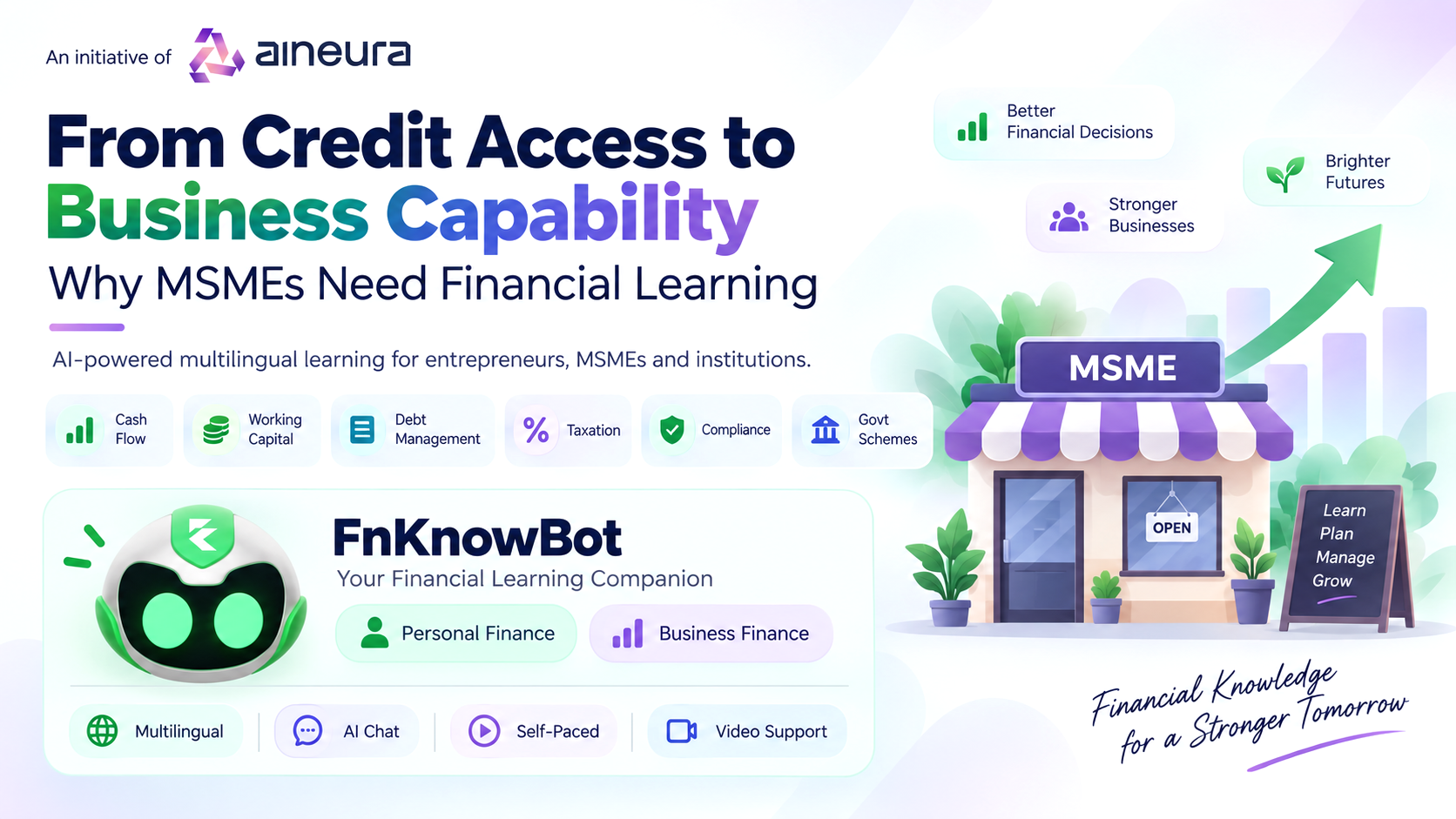
From Credit Access to Business Capability: Why MSMEs Need Financial Learning
Access to finance can help a business grow. Financial capability helps an entrepreneur use that finance more responsibly, sustainably and effectively.
By: Amit R Charan , Founder, Aineura
For MSMEs, access to credit can be transformative. A loan, working-capital facility or other source of finance can help an enterprise purchase assets, manage inventory, expand operations and pursue new opportunities.
But credit access alone does not create business capability.
An entrepreneur must also understand how money moves through the business, what debt really costs, how working capital should be managed, which financial products may be appropriate and how today's decisions can affect tomorrow's liquidity and sustainability.
The Missing Layer Between Finance and Growth
Many small-business owners are experts in their trade, product or service but may never have received structured learning in business finance.
As the enterprise grows, they may suddenly need to understand concepts involving debt, cash flow, taxation, banking documentation, compliance, insurance and financial planning.
Without this foundational understanding, even a viable business can face avoidable financial pressure.
What Financial Learning Should Cover for MSMEs
Business-finance education for entrepreneurs should be practical rather than overly technical. Important areas include:
- Cash flow: understanding inflows, outflows, liquidity and cash-flow gaps;
- Working capital: managing inventory, receivables, payables and short-term funding needs;
- Debt management: understanding interest, repayment capacity, security, guarantees and borrowing costs;
- Banking relationships: understanding facilities, documentation, account conduct and responsible engagement with lenders;
- Financial products: loans, overdrafts, cash-credit facilities, insurance and other business-finance solutions;
- Taxation and compliance: developing awareness around financial records, tax obligations and regulatory discipline;
- Government schemes: understanding relevant support programmes and checking current eligibility through official sources;
- Business planning: budgeting, profitability, reserves, asset purchases and growth decisions.
Personal Finance and Business Finance Are Often Connected
For many small entrepreneurs, the boundary between household finances and business finances can be thin.
Personal savings may fund the business. Family assets may support borrowing. Business income may finance household expenses. Insurance, debt and succession decisions may affect both.
This is why entrepreneurs benefit from understanding both Personal Finance and Business Finance—including savings, budgeting, loans, credit, insurance, investments, financial fraud, succession and retirement planning.
Financial Capability Can Strengthen Business Resilience
Financial learning cannot remove commercial risk. Businesses will still face competition, economic cycles, delayed payments and unexpected expenses.
But an entrepreneur who understands liquidity, debt obligations, reserves and financial risk may be better prepared to recognise problems earlier and respond more prudently.
Why Multilingual Learning Matters
Millions of entrepreneurs conduct their businesses successfully in regional languages, yet much of formal business and financial terminology continues to be communicated in English.
Language should not become a barrier between an entrepreneur and essential financial knowledge.
At Aineura , we have developed FnKnowBot , an AI-powered learning platform covering Personal Finance and Business Finance with support for 15+ Indian languages and major world languages.
Entrepreneurs can begin through guided questions, ask follow-up queries and explore financial concepts in a language they understand more comfortably.
AI Can Make MSME Upskilling More Scalable
Traditional workshops and advisory programmes remain important, but MSMEs often need answers when an actual business decision arises—not only when a training session is scheduled.
AI-powered learning can provide a continuing layer of support through:
- Pre-built business-finance questions;
- Instant explanations and follow-up queries;
- Multilingual learning;
- Study notes and chat history;
- Quizzes and video-supported learning;
- Self-paced access through digital devices.
This can complement banks, financial institutions, incubators, industry bodies, educational institutions, government programmes, NGOs and livelihood initiatives seeking to strengthen MSME capability at scale.
From MSME Development to Viksit Bharat
MSMEs support entrepreneurship, employment, local economies and livelihoods. Strengthening their financial capability therefore has implications beyond the individual enterprise.
In the Indian context, combining access to finance with financial learning, digital inclusion, skilling and multilingual education can contribute to the broader vision of Viksit Bharat.
The opportunity is particularly relevant for small entrepreneurs, women-led enterprises, Self Help Groups, rural businesses, first-generation entrepreneurs and beneficiaries of government and social initiatives.
From Credit Access to Capability
The success of MSME development should not be measured only by how much credit reaches small businesses.
A deeper question is whether entrepreneurs also have access to the knowledge needed to use capital wisely, manage financial obligations and build more sustainable enterprises.
Explore AI-powered multilingual Personal and Business Finance learning with FnKnowBot .
About the Author: Amit R Charan is the Founder of Aineura , an MSME-registered EdTech startup working in the financial-literacy space by leveraging artificial intelligence. At Aineura, he is building FnKnowBot as an AI-powered multilingual learning platform covering Personal Finance and Business Finance for individuals, entrepreneurs, institutions and communities.