How Financial Literacy Can Strengthen Livelihoods and Economic Resilience
From household money management to business finance, stronger financial capability can help individuals, entrepreneurs and communities build more sustainable livelihoods.
By: Amit R Charan , Founder, Aineura
Livelihood programmes often focus on employment, entrepreneurship, skilling, access to credit and income generation.
But earning an income is only one part of economic resilience.
People must also know how to manage that income, protect it, use credit responsibly, plan for uncertainty and make informed financial decisions.
This is where financial literacy becomes an important livelihood skill.
Financial Capability Complements Livelihood Creation
A person may gain employment, start a small enterprise or receive access to formal credit and still remain financially vulnerable.
Without basic financial understanding, increased income can be weakened by excessive borrowing, poor cash-flow management, inadequate insurance, lack of emergency savings or uninformed financial decisions.
Financial learning can therefore complement livelihood and skilling initiatives by helping beneficiaries understand:
- Budgeting and household money management;
- Savings and emergency funds;
- Responsible borrowing and debt management;
- Insurance and financial protection;
- Investments and long-term planning;
- Retirement preparedness;
- Digital payments and financial-fraud awareness.
Entrepreneurs Need Business Finance Learning Too
For entrepreneurs, MSMEs, self-employed individuals and members of Self Help Groups (SHGs), financial capability must go beyond personal finance.
A small business owner may also need to understand:
- Cash flow and liquidity;
- Working capital and operating cycles;
- Business debt and repayment obligations;
- Banking relationships and financial products;
- Pricing, costs and profitability;
- Taxation and compliance awareness;
- Government schemes and policies relevant to entrepreneurs;
- Business budgeting and financial planning.
The objective is not to turn every entrepreneur into an accountant or financial adviser. It is to provide enough foundational understanding to recognise risks, ask better questions and make more informed business decisions.
Financial Literacy for Inclusive Livelihood Programmes
Financial learning can be relevant across a wide range of livelihood and social-impact programmes, including those supporting:
- Women and Self Help Groups;
- Youth and first-time earners;
- Small entrepreneurs and MSMEs;
- Rural and underserved communities;
- Marginalized and underprivileged groups;
- Differently-abled persons;
- Beneficiaries of government schemes and social initiatives;
- Informal workers and self-employed individuals.
For such groups, financial literacy can strengthen the value of skilling, credit access and livelihood support by helping beneficiaries use financial opportunities more responsibly.
Breaking Language Barriers Is Essential
Livelihood programmes often serve communities where English may not be the preferred language of learning.
Financial terminology can itself become a barrier if concepts such as working capital, insurance exclusions, credit scores or investment risk are not explained in a language the learner understands comfortably.
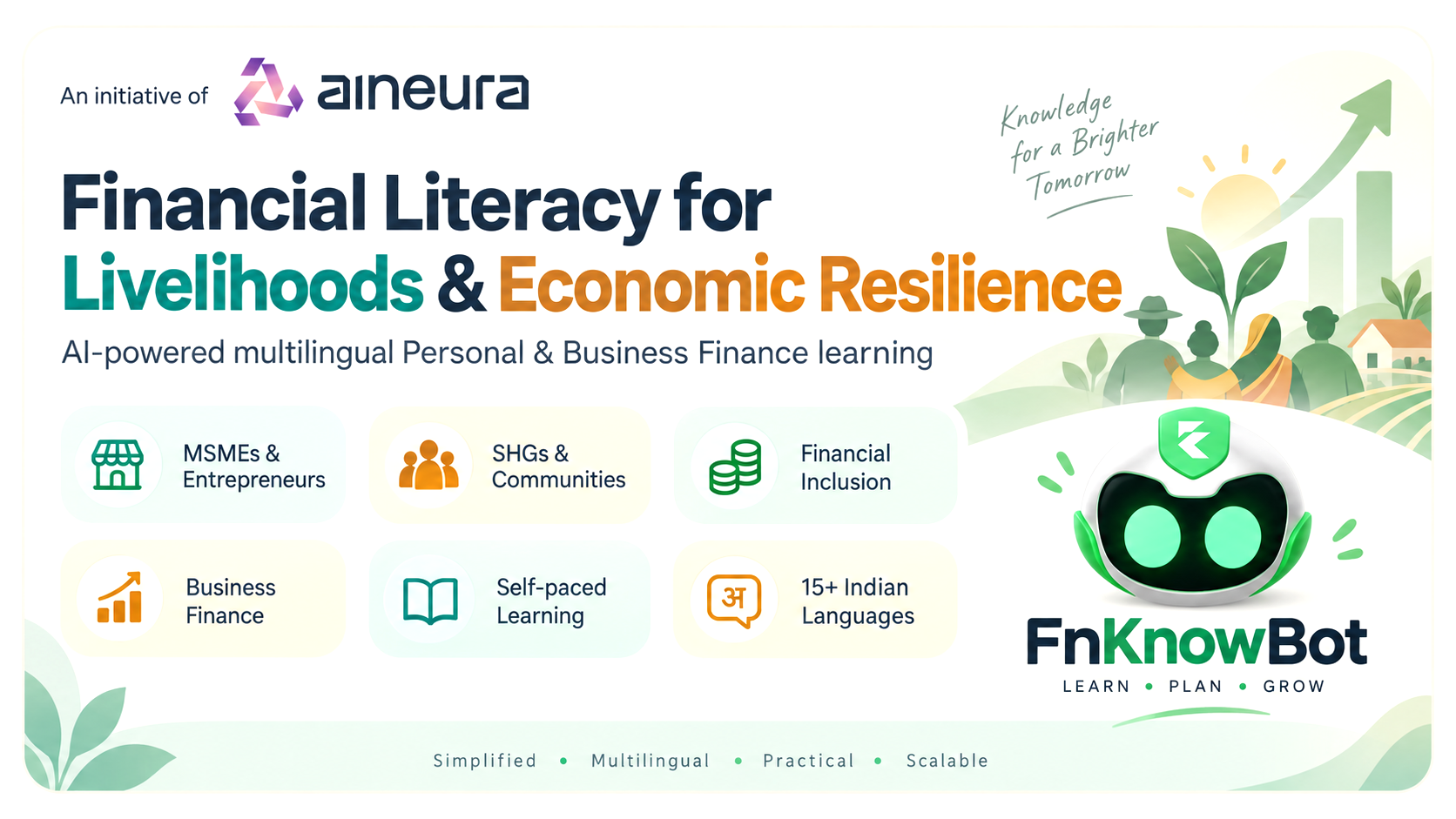
At Aineura , we have developed FnKnowBot , an AI-powered learning platform covering both Personal Finance and Business Finance.
FnKnowBot supports 15+ Indian languages, helping learners explore financial concepts in their preferred or heart language.
This multilingual capability can make financial learning more relevant for grassroots programmes, SHGs, regional entrepreneurs, rural communities and first-generation learners.
AI Can Extend Livelihood Learning Beyond the Workshop
Many livelihood programmes begin with training sessions, workshops or facilitator-led interventions.
The challenge is what happens afterwards.
AI-powered learning can allow beneficiaries to continue asking questions, revisit concepts and learn when an actual financial decision arises.
FnKnowBot supports:
- Structured pre-built questions;
- Instant AI-powered clarification;
- Follow-up questions;
- Self-paced learning;
- Study notes and chat history;
- Quizzes and video-supported learning;
- Multilingual access through one platform.
This can complement trainers, NGOs, livelihood missions and field facilitators rather than replace them—creating a continuing learning layer beyond the initial intervention.
From Livelihood Support to Economic Resilience
Economic resilience means being better prepared to absorb financial shocks, manage uncertainty and continue making informed decisions during difficult periods.
Financial literacy cannot eliminate unemployment, business losses, emergencies or economic downturns. But it can help individuals and entrepreneurs understand concepts such as emergency savings, insurance, debt exposure, liquidity and diversification before a crisis occurs.
That makes financial capability a natural complement to livelihood creation.
Financial Capability and the Vision of Viksit Bharat
For India, stronger livelihoods, MSME growth, skilling, financial inclusion and digital participation are closely connected with the broader vision of Viksit Bharat.
Financial learning can contribute to this journey by helping people not only access economic opportunities, but understand how to use those opportunities more effectively.
When financial education is available across major Indian languages, it can reach deeper into the communities where livelihood and inclusion programmes can have some of their greatest impact.
A Model That Can Extend Across Geographies
The connection between financial capability and livelihoods is not unique to India.
International development organisations, foundations, NGOs and governments across the world work on education, livelihoods, financial inclusion, entrepreneurship and economic empowerment.
FnKnowBot also supports major world languages. With appropriate localisation for country-specific products, regulations, taxation, government programmes and financial terminology, the platform can progressively support livelihood and financial-literacy initiatives across geographies.
Its digital architecture can also complement institutional learning portals, LMS environments, NGO programmes and community-based interventions seeking a scalable conversational learning layer.
Building Livelihoods That Last
A livelihood programme can help someone earn.
Financial literacy can help that person understand how to manage what is earned, protect against financial shocks, use credit more responsibly and plan for the future.
That is the difference between creating an income opportunity and helping build long-term economic capability.
Explore AI-powered multilingual Personal and Business Finance learning with FnKnowBot .
About the Author: Amit R Charan is the Founder of Aineura , an MSME-registered EdTech startup working in the financial-literacy space by leveraging artificial intelligence. At Aineura, he is building FnKnowBot as an AI-powered multilingual learning platform covering Personal Finance and Business Finance for individuals, entrepreneurs, institutions and communities.