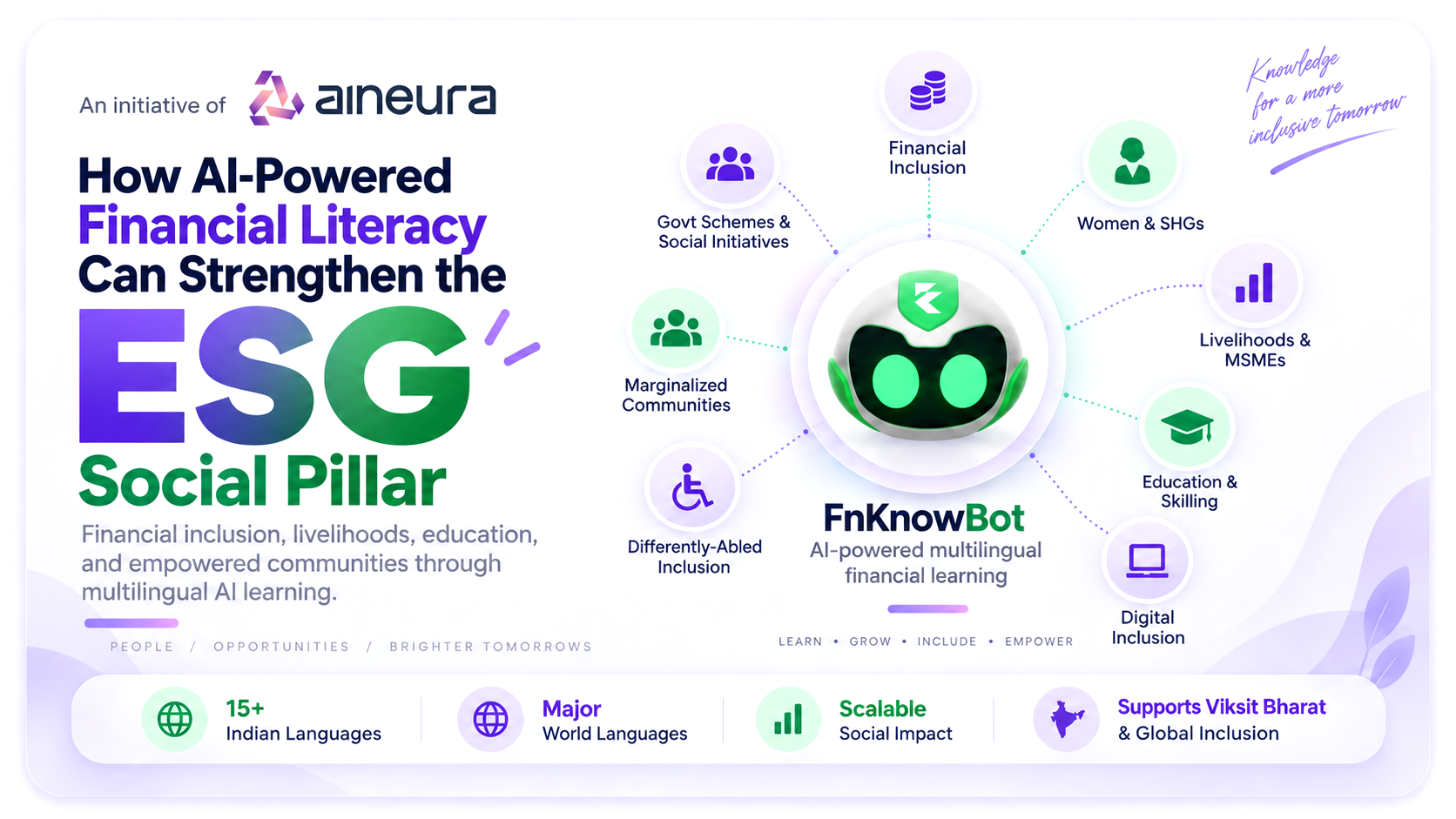
How AI-Powered Financial Literacy Can Strengthen the Social Pillar of ESG
From financial inclusion and employee well-being to livelihoods, community empowerment and measurable social impact.
By: Amit R Charan , Founder, Aineura
ESG conversations often focus heavily on environmental targets and governance standards. Yet the “S” in ESG—the Social pillar—is ultimately about people: employees, customers, entrepreneurs, families, communities and other stakeholders affected by an organisation.
Financial literacy can become a practical and scalable way of strengthening this social dimension.
When people understand savings, budgeting, borrowing, insurance, investments, retirement, financial fraud and basic financial planning, they are better positioned to participate in economic life with greater awareness and confidence.
Financial Literacy as a Social-Impact Intervention
Financial capability connects naturally with several objectives commonly associated with the Social pillar of ESG:
- Employee well-being: helping employees understand budgeting, debt, insurance, investments and retirement planning;
- Customer empowerment: enabling more informed understanding of financial products, obligations, benefits and risks;
- Financial inclusion: moving beyond access to banking and financial products towards informed participation;
- Livelihoods and entrepreneurship: strengthening financial capability among entrepreneurs, MSMEs and self-employed individuals;
- Community empowerment: extending financial learning to women, youth, Self Help Groups (SHGs), marginalized and underprivileged communities;
- Inclusive learning: creating accessible learning pathways for differently-abled persons and other beneficiary groups who may face barriers to conventional financial education.
Financial literacy therefore need not remain a one-time awareness exercise. It can become part of a broader strategy for social inclusion, economic resilience and sustainable empowerment.
From Financial Inclusion to Financial Capability
Opening a bank account, receiving formal credit or gaining digital access is important—but access alone does not necessarily create financial capability.
People also need to understand what a financial product does, what it costs, what obligations it creates, what risks are involved and whether it is appropriate for their circumstances.
This distinction matters for organisations seeking deeper ESG outcomes. Financial inclusion becomes more meaningful when people can use financial services with greater understanding, confidence and responsibility.
The same principle can strengthen government schemes and social initiatives. Providing access to financial benefits or services is important; helping beneficiaries understand how to use, manage and protect those resources can deepen the impact.
Livelihoods, MSMEs and Economic Resilience
For entrepreneurs, MSMEs, SHGs, self-employed workers and livelihood beneficiaries, financial literacy must extend beyond personal finance.
They may also need practical understanding of:
- Cash-flow management;
- Working capital;
- Business borrowing and debt management;
- Banking relationships;
- Financial products and insurance;
- Taxation and compliance awareness;
- Government schemes, policies and available support;
- Business budgeting and financial planning.
Strengthening this understanding can support entrepreneurial upskilling, more sustainable livelihoods and greater economic resilience—important outcomes for ESG, CSR and social-impact programmes.
AI Can Help Take Social Impact to Scale
Traditional financial-literacy programmes often depend on workshops, facilitators, printed material or video modules. These remain valuable, but providing continuous learning across large and diverse beneficiary groups can be challenging.
AI-powered learning can add an interactive layer by allowing people to begin with guided questions, ask their own questions, seek clarification and continue learning at their own pace.
For institutions, this can support:
- Large-scale programme deployment;
- Multiple beneficiary groups and locations;
- Multilingual learning;
- Self-paced and facilitator-supported learning;
- Reduced dependence on repeated classroom delivery;
- Programme monitoring and learning assessments;
- Data-led improvement of future interventions.
Breaking Language Barriers—and Deepening Inclusion
Social impact cannot be truly inclusive if essential financial knowledge remains difficult to understand because of language.
At Aineura , we have developed FnKnowBot , an AI-powered learning platform covering both Personal Finance and Business Finance.
FnKnowBot supports 15+ Indian languages, enabling financial learning to reach customers, employees, students, entrepreneurs, SHGs and communities in languages they understand more comfortably.
In the Indian context, such multilingual financial capability-building can complement the broader vision of Viksit Bharat by supporting financial inclusion, digital inclusion, skilling, entrepreneurship and more informed economic participation.
Language inclusion can be especially important when programmes seek to reach rural communities, marginalized groups, underprivileged beneficiaries or first-generation digital learners.
From ESG Activity to Measurable Social Outcomes
For ESG programmes to create lasting value, organisations should look beyond the activity itself and ask what happened as a result.
Digital financial-learning programmes can help institutions monitor indicators such as:
- Beneficiary reach and participation;
- Learning engagement;
- Preferred topics and languages;
- Learning continuity;
- Quiz or assessment outcomes;
- Programme-level learning gaps.
Such indicators do not by themselves prove long-term social impact, but they can contribute to monitoring, impact assessment, programme improvement and stronger ESG reporting.
A Social-Impact Model with Global Relevance
The need for inclusive digital learning extends well beyond India.
International organisations are increasingly investing in public digital-learning infrastructure, flexible learning-management systems, multilingual access and inclusive education. Recent initiatives of organisations such as UNESCO, UNICEF and ITU emphasise inclusive, accessible and interoperable digital-learning platforms, while UNICEF's Learning Passport demonstrates how digital learning can operate across online, mobile and offline environments.
These developments reinforce a larger opportunity: specialised conversational learning tools can complement broader education and LMS ecosystems by adding domain-specific capability building.
FnKnowBot also supports major world languages. With appropriate localisation for country-specific financial products, regulations, policies and terminology, the platform can progressively support financial-literacy, financial-inclusion, livelihood and education programmes across geographies.
This creates potential relevance for international organisations, foundations, development agencies, NGOs, educational institutions and social-impact programmes seeking scalable financial capability-building solutions.
Strengthening the “S” Through Financial Empowerment
The Social pillar of ESG is ultimately about whether institutions are helping create stronger, more inclusive and more resilient societies.
Financial literacy provides a practical pathway to support employees, customers, MSMEs, SHGs, marginalized and underprivileged communities, livelihood beneficiaries and participants in government and social initiatives.
AI can help make that learning more interactive, multilingual, scalable and measurable.
Explore AI-powered multilingual Personal and Business Finance learning with FnKnowBot .
About the Author: Amit R Charan is the Founder of Aineura , an MSME-registered EdTech startup working in the financial-literacy space by leveraging artificial intelligence. At Aineura, he is building FnKnowBot as an AI-powered multilingual learning platform covering Personal Finance and Business Finance for individuals, institutions, entrepreneurs and communities.