Building Financial Capability at Scale: A Digital Learning Model for Global Development Organisations
How multilingual, country-adaptable AI can help development agencies, foundations and international organisations deliver accessible and measurable financial learning across communities.
By: Amit R Charan , Founder, Aineura
Financial inclusion has expanded access to banking, digital payments, credit and other financial services across many parts of the world.
But access alone does not necessarily create financial capability.
People also need to understand how to manage money, evaluate debt, use insurance, recognise financial risk, protect themselves from fraud and make informed financial decisions. For entrepreneurs and livelihood communities, that understanding must extend further into cash flow, working capital, business borrowing, banking relationships and financial planning.
For global development organisations, the challenge therefore is not merely to create more financial-literacy content. It is to make that learning scalable, locally relevant, multilingual, accessible and measurable across countries and communities.
The Challenge: Scaling Without Losing Local Relevance
A global development programme may operate across several countries, languages, implementation partners and beneficiary groups.
A financial-learning programme suitable for one geography cannot simply be copied unchanged into another. Banking systems, financial products, taxation, consumer-protection rules, government programmes, currencies and terminology may differ significantly.
At the same time, rebuilding an entirely new digital learning system for every country can become expensive, fragmented and difficult to scale.
One Digital Platform, Multiple Country Contexts
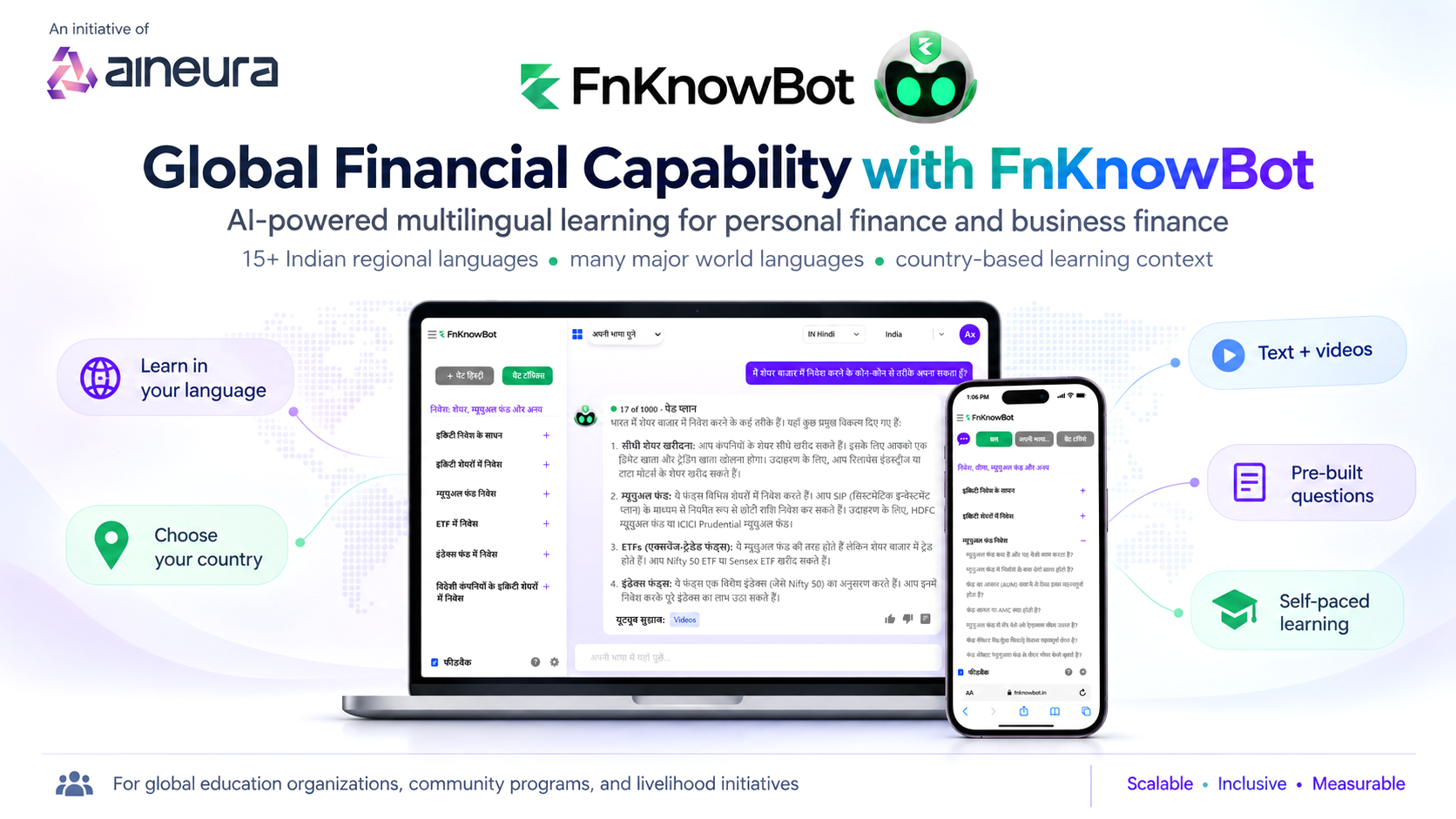
At Aineura , we are developing FnKnowBot as an AI-powered financial-learning platform that combines multilingual capability with a preferred country selection.
This is important because global financial education requires more than translation.
A learner can select a preferred country and language, allowing the learning experience to be progressively adapted around the financial context relevant to that geography.
Depending on programme requirements, localisation can reflect areas such as:
- Local banking and financial systems;
- Country-specific financial products and terminology;
- Currencies and financial practices;
- Taxation and compliance concepts;
- Consumer-protection frameworks;
- Government and livelihood-support programmes;
- Local educational and regulatory disclaimers.
Language as Infrastructure for Inclusion
A learner may technically have access to digital education and still remain excluded if the learning experience is available only in an unfamiliar language.
FnKnowBot supports many major world languages such as English, French, German, Spanish, Mandarin, Nepali and Bengali, along with 15+ Indian regional languages.
For international programmes, this creates the possibility of using one underlying technology platform while providing different language experiences across beneficiary populations.
Additional language and country localisation can also be developed progressively depending on programme requirements.
The objective is not merely linguistic translation. It is to help people learn financial concepts in a language and context that they can understand and use.
A Modular Financial-Capability Model
Different development programmes serve different populations. A student, salaried worker, farmer, micro-entrepreneur and small-business owner may not require the same learning journey.
FnKnowBot can support multiple financial-learning pathways within one platform.
Personal and Household Financial Capability
Learning can cover budgeting, savings, banking, loans, credit cards, insurance, investments, retirement planning, financial risk and fraud prevention.
Livelihood and Business Finance Capability
For farmers, women-led enterprises, micro-entrepreneurs, shop owners, cooperatives, livelihood groups and SME/MSME businesses, learning can extend to cash flow, working capital, business debt, banking relationships, financial products, taxation, compliance and business planning.
This enables development organisations to support both household financial resilience and livelihood-related financial capability through the same digital infrastructure.
Designed for Learners Who May Not Know What to Ask
One challenge with open-ended AI systems is that users must know what question to ask before learning can begin.
FnKnowBot addresses this through structured pre-built questions across financial topics, helping learners begin even when they have little prior knowledge.
The learning experience can combine:
- Pre-built questions;
- AI-powered explanations;
- Instant follow-up queries;
- Text-based learning;
- Video-supported learning;
- Study notes;
- Quizzes for reinforcement;
- Self-paced learning and continued access.
This can help move financial education away from dependence on a single workshop or trainer towards a learning resource that beneficiaries can return to when a real financial question arises.
A Platform for Global Programmes and Local Partners
Large development programmes frequently work through country offices, NGOs, educational institutions, community organisations and other implementation partners.
A digital learning layer can complement that structure rather than replace it.
A possible deployment model can be:
↓
Common Digital Financial-Learning Platform
↓
Country + Language + Programme Localisation
↓
Local NGOs / Educational / Community Partners
↓
Individuals • Families • Entrepreneurs • Livelihood Groups • Small Businesses
The technology provides scale and consistency, while local implementation partners continue to provide trust, cultural understanding, facilitation and human support.
From Reach to Measurable Learning Engagement
For development organisations, scale must also be accompanied by visibility into whether beneficiaries are actually using the learning resource.
Depending on institutional implementation and programme design, a digital platform can support measurement of indicators such as:
- Learners reached and activated;
- Languages selected;
- Topics explored;
- Repeat engagement;
- Learning continuity;
- Quiz participation;
- Usage across different beneficiary groups or locations.
These indicators can provide useful evidence of reach and learning engagement. They should not, by themselves, be treated as proof of behavioural, livelihood or economic outcomes, which may require separate programme evaluation.
That distinction is important for responsible and credible impact measurement.
From Financial-Literacy Projects to Financial-Capability Infrastructure
A financial-literacy intervention should ideally leave behind more than awareness.
It should leave behind capability.
When a learner can return months later to understand a loan, compare insurance concepts, explore a business cash-flow problem, learn about working capital or recognise a potential financial fraud, financial education begins to move from a one-time activity towards continuing digital infrastructure.
For global development organisations, this creates the possibility of building programmes that are scalable across geography while remaining adaptable to local language, country context and beneficiary needs.
Through FnKnowBot, Aineura is working towards building such a scalable financial-learning model—combining Personal Finance, Business Finance, country adaptability, multilingual learning, AI-powered interaction and measurable digital engagement within one platform.
The long-term opportunity is global: enabling development organisations and their implementation partners to make financial capability more accessible to individuals, families, entrepreneurs, livelihood communities and small businesses across geographies.
Explore FnKnowBot and experience AI-powered financial learning across languages and country contexts.
About the Author: Amit R Charan is the Founder of Aineura , a DPIIT-recognised and MSME-registered EdTech startup working in the financial-literacy space by leveraging artificial intelligence. At Aineura, he is building FnKnowBot as an AI-powered multilingual Personal Finance and Business Finance learning platform capable of supporting individuals, institutions, entrepreneurs and communities across countries.