Amit R Charan
From CSR Spend to Sustainable Impact: Financial Literacy That Creates Lasting Change
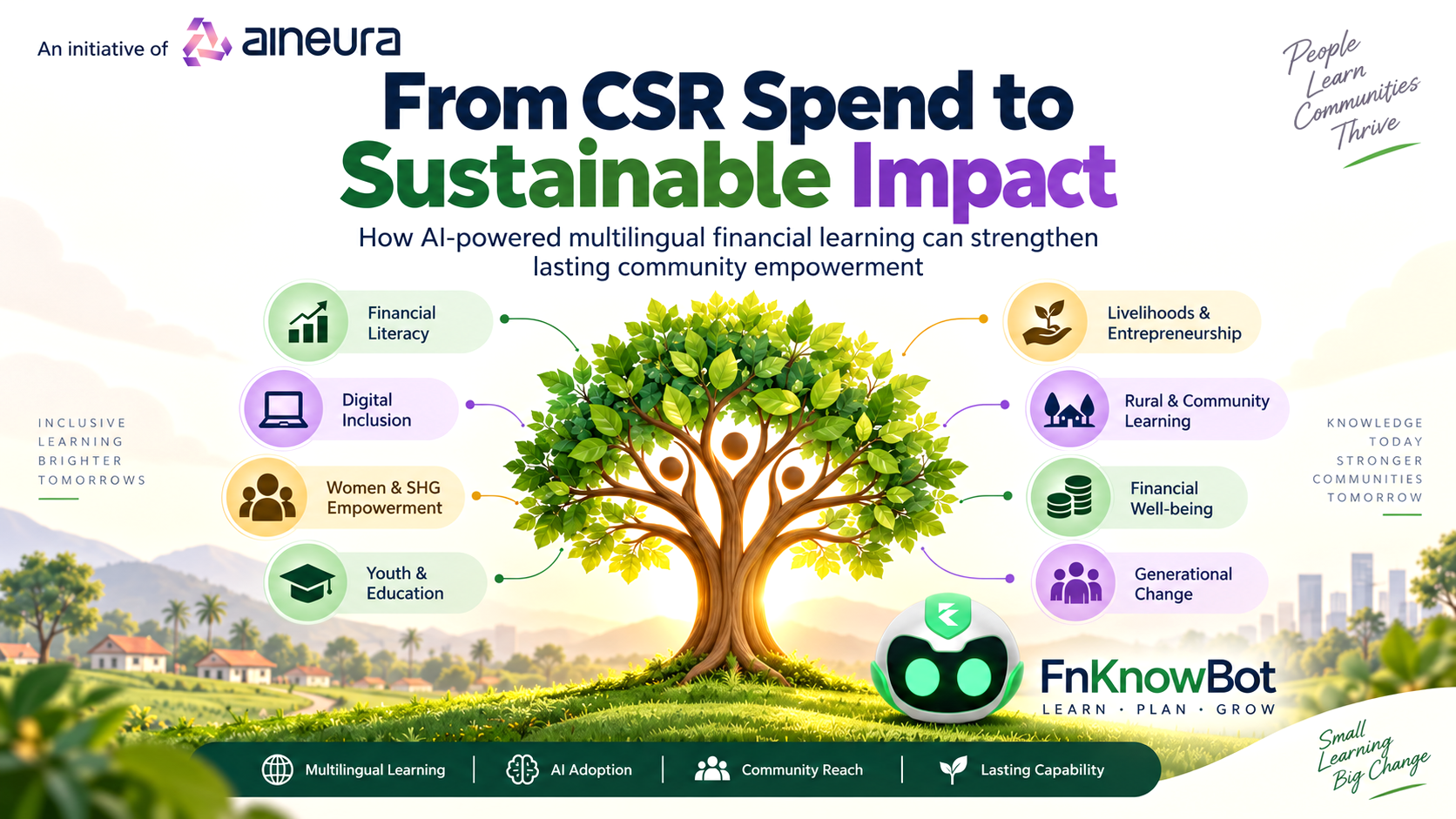
From CSR Spend to Sustainable Impact: Making Financial Literacy Create Lasting Change
How corporates, NGOs, non-profits and impact partners can move beyond one-time awareness programmes towards scalable, multilingual and continuing financial empowerment.
By: Amit R Charan , Founder, Aineura
CSR creates its deepest value when the objective is not simply to deploy funds, conduct an activity or reach a numerical target—but to leave people with knowledge and capabilities that continue benefiting them after the programme ends.
Financial literacy is particularly suited to this approach.
When individuals better understand savings, budgeting, borrowing, insurance, investments, financial fraud, retirement planning or business finance, that knowledge can influence decisions repeatedly over many years. It can also travel into families, livelihoods, enterprises and communities.
The Limitation of One-Time Awareness
Workshops, camps, presentations and awareness drives remain valuable. They can introduce a subject, mobilise communities and create initial engagement.
But financial questions rarely arise only during the workshop.
A learner may understand budgeting today, need help with a loan several months later, explore insurance after a family event, start a small business, or need guidance around working capital or financial fraud at another stage of life.
If learning disappears when the programme session ends, much of its potential impact may disappear with it.
Sustainable Impact Requires Continuity
A stronger financial-literacy programme should enable beneficiaries to continue learning after the initial intervention.
They should be able to:
- Revisit concepts they did not fully understand;
- Ask questions without hesitation;
- Learn at their own pace;
- Access explanations in a familiar language;
- Refresh learning when a real financial decision arises;
- Build progressively from awareness towards financial capability.
This is where digital learning and responsible AI adoption can extend the life and reach of a CSR intervention.
Financial Literacy Can Support Multiple Impact Missions
Financial capability is not an isolated social objective. It can strengthen several existing CSR and development missions.
Financial-learning programmes can be integrated into initiatives relating to:
- Women and SHG empowerment — savings, borrowing, insurance, livelihood finance, financial independence and business basics;
- Youth and education — budgeting, banking, credit, investing and fraud awareness before major financial responsibilities begin;
- Livelihoods, entrepreneurship and small businesses — supporting farmers, SHGs, grocery and small retail businesses, micro-entrepreneurs, SME/MSME owners and livelihood activities such as pisciculture, sericulture, beekeeping and allied enterprises with learning around cash flow, working capital, borrowing, banking relationships, taxation, compliance, government schemes, financial products and business planning;
- Rural and underserved communities — practical financial learning alongside digital inclusion;
- Senior citizens and families — fraud awareness, insurance, retirement planning, succession and financial security.
This creates an important distinction. Financial empowerment is not limited to helping someone manage household money better. For millions of people, financial capability is directly connected with their livelihood or enterprise.
A small entrepreneur may need to understand working capital and debt. A farmer or allied livelihood operator may need to understand banking facilities, insurance, government schemes and cash-flow planning. A shop owner may need greater clarity on business budgeting, taxation, compliance or financing options.
One Platform for Personal Finance and Business Finance
At Aineura , we are building FnKnowBot as an AI-powered multilingual learning platform covering both Personal Finance and Business Finance.
On the Personal Finance side, learners can explore topics such as budgeting, savings, loans, credit cards, insurance, investments, retirement planning, debt management and financial-fraud awareness.
On the Business Finance side, entrepreneurs and small-business owners can learn about banking relationships, cash-flow management, working capital, business debt, taxation, compliance, government schemes, financial products and business financial planning.
Bringing these two dimensions together allows a social-impact programme to support both the individual and the economic activity that sustains the individual’s family.
Language Can Determine Whether Inclusion Is Real
A programme may reach a beneficiary physically and still fail to reach them intellectually.
Financial and business-finance concepts can already be intimidating. When they are explained only in English or through technical terminology, many learners may hesitate to participate.
FnKnowBot supports 15+ Indian languages and major world languages, helping learners explore financial concepts in a language they understand more naturally.
For CSR and community programmes, multilingual learning can help reduce language barriers and make financial education more relevant across rural, semi-urban and underserved communities.
Combining Human Trust with AI-Powered Scale
Technology should not replace NGOs, trainers, community workers or field facilitators.
Their local understanding, trust and human connection remain critical.
The stronger model is to combine that human layer with technology that can provide structured learning repeatedly and at scale.
FnKnowBot can support programmes through:
- Pre-built learning questions;
- AI-powered explanations and follow-up queries;
- Multilingual learning;
- Study notes and quizzes;
- Text and video-supported learning;
- Self-paced access beyond programme sessions.
Impact Should Be Measured Beyond Beneficiary Numbers
For CSR leaders and impact investors, the number of beneficiaries reached remains important—but it should not be the only measure.
Digital financial-learning programmes can also examine indicators such as:
- Learners who actually engage with the platform;
- Repeat learning and continued participation;
- Topics most frequently explored;
- Language preferences;
- Quiz participation and learning progression;
- Reach across different learner and livelihood groups.
These measures do not automatically prove behavioural change or financial outcomes, but they can provide useful evidence of whether beneficiaries are genuinely engaging with the programme rather than merely being counted as attendees.
Why This Matters to Impact Investors
Impact-oriented capital increasingly looks for models capable of combining social value with scalability and operational sustainability.
A technology-enabled financial-learning platform has the potential to support that intersection by combining:
- A large and continuing social need;
- Institution-led distribution;
- Digital inclusion;
- Multilingual accessibility;
- Scalable delivery;
- Potential for measurable engagement;
- Applicability across communities, livelihood groups and geographies.
For impact investors, this expands the potential impact pathway considerably. The same technology can support financial well-being at the household level while also contributing to entrepreneurial upskilling, livelihood sustainability and financial capability among micro, small and medium businesses.
The impact proposition is therefore not simply that more people receive financial information. It is that more people are given an opportunity to continue learning and progressively build financial capability.
From Annual CSR Activity to Lasting Capability
A CSR programme may be funded for a defined period, but the knowledge created through it need not expire with the funding cycle.
A student becomes an employee. An employee becomes a borrower or investor. A farmer may diversify a livelihood. A small entrepreneur may grow into an MSME. A family begins planning for insurance, retirement or succession.
The same foundation of financial knowledge can remain relevant across those transitions.
Through FnKnowBot, Aineura is working towards enabling corporates, CSR programmes, NGOs, non-profits and impact partners to take Personal Finance and Business Finance learning deeper into communities—supporting individuals, families, entrepreneurs, livelihood groups and small businesses through AI, multilingual access and digital inclusion.
Explore AI-powered multilingual financial learning with FnKnowBot .
About the Author: Amit R Charan is the Founder of Aineura , a DPIIT-recognised and MSME-registered EdTech startup working in the financial-literacy space by leveraging artificial intelligence. At Aineura, he is building FnKnowBot as an AI-powered multilingual learning platform covering Personal Finance and Business Finance for individuals, institutions, entrepreneurs, small businesses and communities.