Amit R Charan
Employee Financial Wellness: Why Corporates Should Go Beyond Salary and Benefits
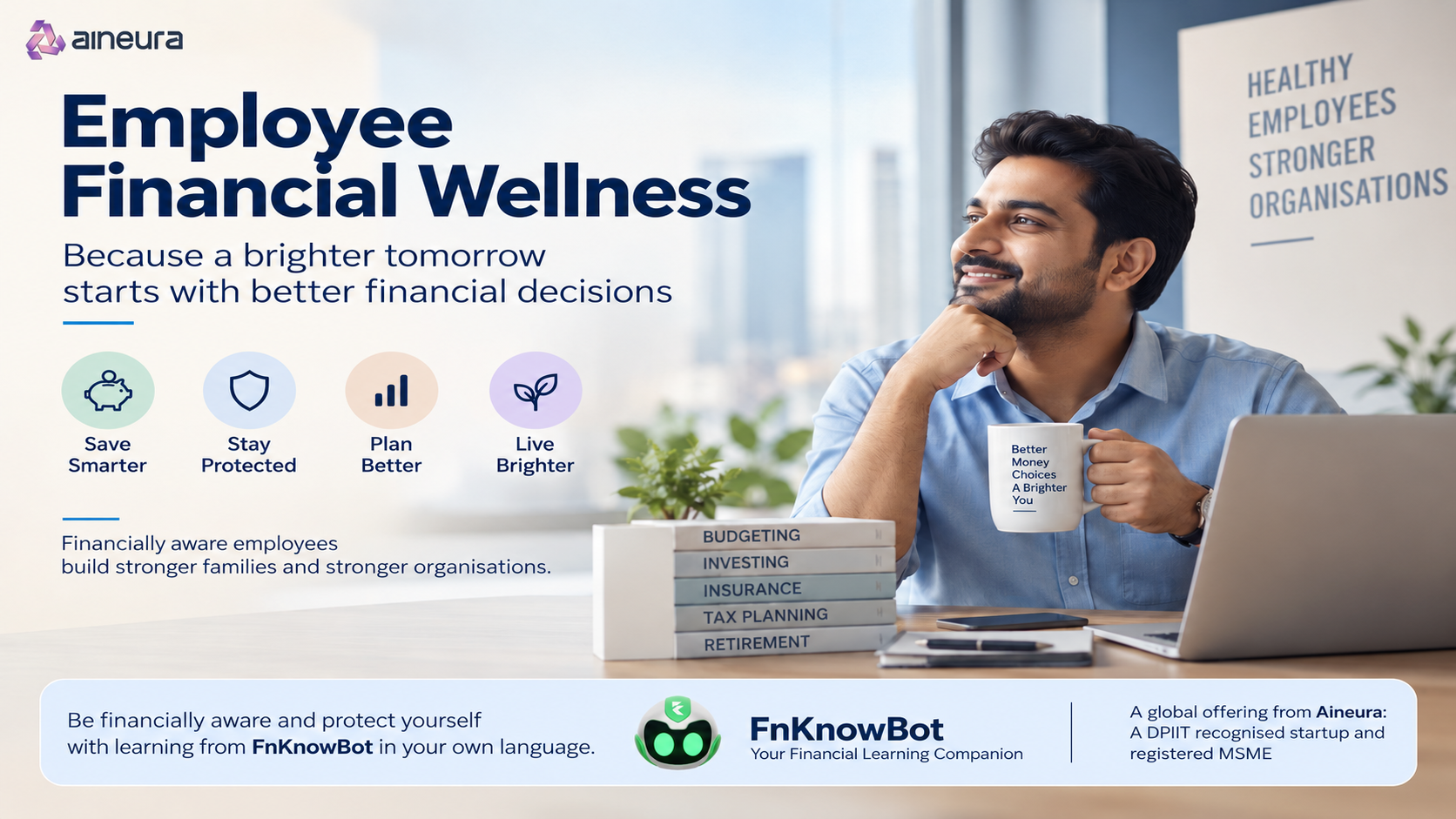
Employee Financial Wellness: Why Corporates Should Go Beyond Salary and Benefits
How AI-powered financial learning can help employees manage money better, reduce financial uncertainty and build long-term financial confidence.
By: Amit R Charan , Founder, Aineura
A regular salary does not automatically translate into financial well-being.
Employees may earn steadily and still struggle with credit-card debt, inadequate savings, insufficient insurance, poor budgeting, investment confusion, tax-related decisions or uncertainty about retirement.
Corporates increasingly invest in employee health, insurance, learning, mental well-being and workplace benefits. Financial wellness deserves a place within this wider employee well-being ecosystem.
The objective is not to tell employees where to invest or what financial product to buy. It is to help them understand financial concepts, evaluate choices and develop greater confidence in managing their own money.
Financial Wellness Is More Than a Salary
An employee’s financial life extends far beyond the monthly salary credit.
It includes decisions about:
- Monthly budgeting and household expenses;
- Emergency savings;
- Credit cards and personal loans;
- Debt repayment and credit scores;
- Health and life insurance;
- Investments and asset allocation;
- Tax-related financial planning;
- Retirement preparedness;
- Nomination, succession and family protection;
- Financial-fraud awareness.
When these areas are poorly understood, even a good income may not result in financial security.
Why Should Corporates Care?
Financial concerns can follow employees into the workplace.
Questions around debt, major expenses, medical emergencies, children’s education, retirement or investment losses can create uncertainty and distraction.
Corporates cannot solve every personal financial problem, nor should they assume responsibility for an employee’s individual financial decisions. But they can provide access to structured financial education that helps employees become better informed.
This can become part of a broader employee-value proposition centred on learning, well-being and long-term capability building.
From One-Time Workshops to Continuous Financial Learning
Financial-wellness programmes are often delivered through occasional webinars or workshops.
These remain useful, but personal finance does not arise only on the day of a workshop.
An employee may want to understand health insurance today, a home loan next month and retirement planning several years later.
This is why employee financial wellness can benefit from a continuous learning layer that employees can return to whenever a financial question arises.
A self-paced model also gives employees the privacy to explore basic questions without feeling embarrassed about what they may not know.
How AI Can Support Employee Financial Wellness
AI-powered learning can make financial education more interactive and accessible.
Instead of navigating through lengthy financial content, employees can begin with structured questions and progressively explore the areas that matter to them.
At Aineura , an MSME-registered EdTech startup working in the financial-literacy space by leveraging AI, we are building FnKnowBot as a multilingual personal and business finance learning platform.
For employee financial wellness, FnKnowBot can support:
- Pre-built questions across financial topics;
- AI-powered explanations and follow-up queries;
- Self-paced learning;
- Chat history and study notes;
- Quizzes for reinforcing understanding;
- Text and video-supported learning;
- Financial-fraud awareness;
- Continuous access beyond scheduled training sessions.
Breaking Language Barriers in the Workplace
A diverse workforce may include employees with very different levels of financial knowledge and language comfort.
Financial terminology can itself discourage learning when explanations are available only in English or use complex technical language.
FnKnowBot supports 15+ Indian languages and major world languages, allowing employees to explore financial concepts in a language they understand more naturally.
For organisations with geographically distributed or multilingual workforces, this can make employee financial learning more inclusive and scalable.
The Impact Can Extend to Employees’ Families
Money decisions are rarely made in isolation.
An employee who develops better understanding of budgeting, insurance, borrowing, investments or fraud prevention may take that knowledge home.
It can influence conversations with spouses, parents and children and contribute to stronger household financial habits.
This gives employee financial wellness a broader social dimension. A corporate initiative aimed at one employee can potentially create benefits across an entire family.
Easy to Integrate Into the Corporate Ecosystem
Employee financial learning should also be easy for organisations to implement.
FnKnowBot can be provided through a dedicated institutional deployment or integrated with existing corporate portals, intranets, employee platforms or applications.
This allows organisations to add an AI-powered financial-learning layer to their employee-wellness ecosystem without having to build an entire financial education platform from the ground up.
Financial Wellness Is Education—not Financial Advice
A responsible employee financial-wellness programme should maintain an important boundary.
The purpose is not to recommend particular investments, insurance policies, loans or financial products to employees.
Rather, financial learning should help employees understand concepts, risks, benefits, alternatives and questions they may wish to consider before taking an important financial decision.
Where personalised professional advice is required, employees should consult appropriately qualified professionals.
From Employee Benefits to Employee Empowerment
Salary, insurance and workplace benefits remain important components of employee welfare.
But organisations can go a step further by helping employees develop the knowledge required to manage their financial lives more confidently.
AI-powered, multilingual and self-paced financial learning can make that support available continuously and at scale.
Explore AI-powered, multilingual and self-paced financial learning with FnKnowBot .
About the Author: Amit R Charan is the Founder of Aineura , an MSME-registered EdTech startup working in the financial-literacy space by leveraging artificial intelligence. He is an author and a corporate lawyer with close to two decades of professional experience in banking and finance. At Aineura, he is building FnKnowBot as an AI-powered multilingual personal and business finance learning platform designed to make financial education more simplified, accessible and impactful for individuals, institutions and communities.