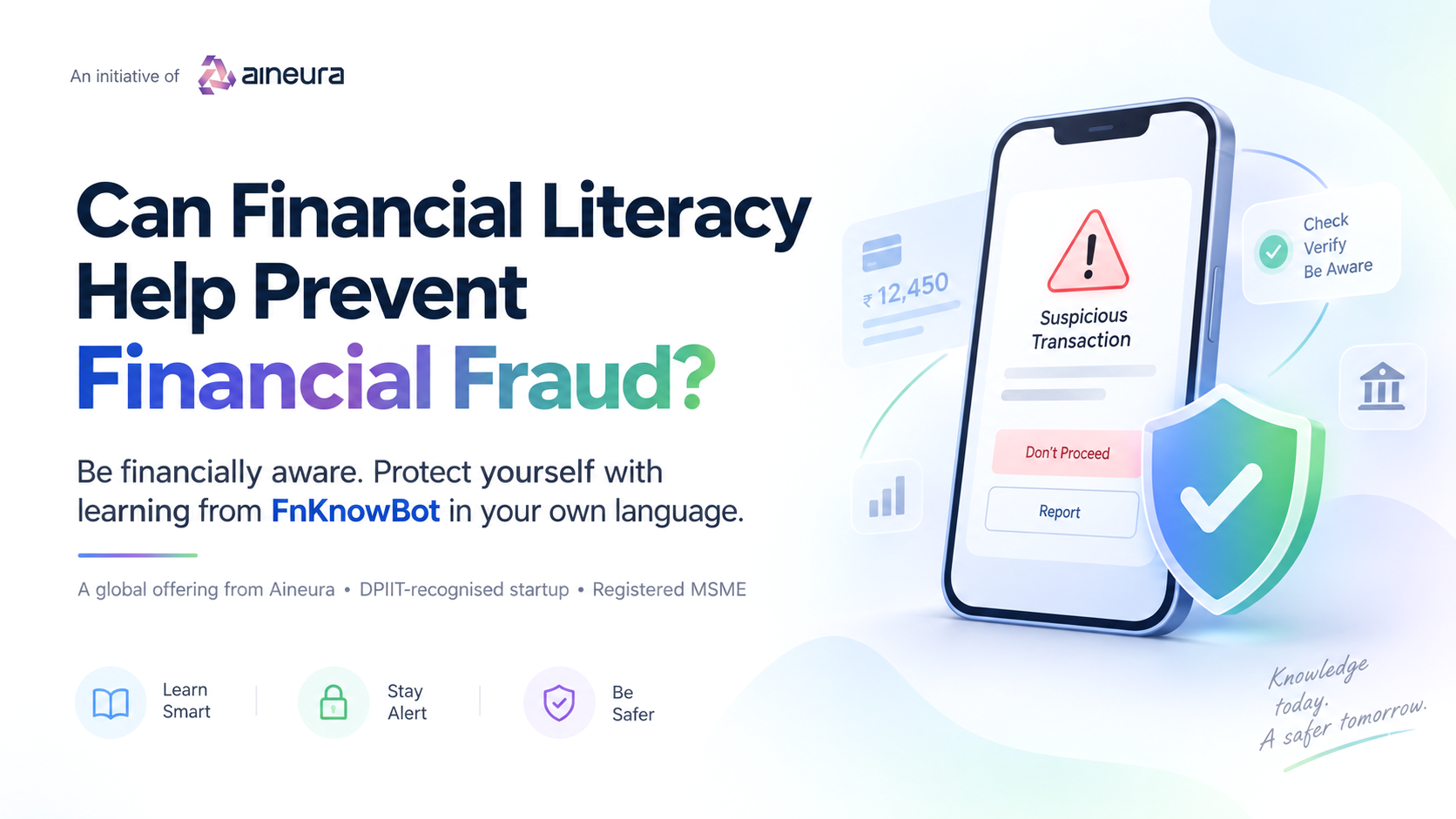
Can Financial Literacy Help Prevent Financial Fraud? Building Awareness Before People Become Victims
How individuals, BFSIs, corporates, educational institutions, NGOs and CSR-led initiatives can strengthen fraud awareness through continuing financial education.
By: Amit R Charan , Founder, Aineura
Financial fraud often succeeds not because people are careless, but because fraudsters exploit gaps in knowledge, urgency, fear, misplaced trust and unfamiliarity with financial processes.
A fake bank call, fraudulent investment offer, suspicious KYC message or request for an OTP can appear convincing when the recipient does not know what legitimate financial institutions normally ask—or what they should never ask.
Financial literacy cannot eliminate fraud, nor can it guarantee that someone will never become a victim. But it can create an important first layer of protection by helping people recognise warning signs, pause before acting, verify information and make more informed decisions.
Financial Fraud Is Also a Financial-Literacy Challenge
Financial education is often associated with budgeting, savings, insurance, loans and investments. Fraud awareness should be treated as an equally important part of that learning.
People increasingly manage money through mobile banking, UPI, cards, online investment platforms, digital lending applications and other technology-enabled channels. Greater digital access creates convenience, but it also makes basic financial and digital awareness increasingly important.
People should know how to identify common warning signs such as:
- Requests for OTPs, PINs, passwords or card credentials;
- Fake KYC or account-blocking messages;
- Suspicious links and QR-code requests;
- Fake customer-care numbers and impersonation calls;
- Requests to install screen-sharing or remote-access applications;
- Guaranteed or unusually high investment returns;
- Fake trading, crypto or investment platforms;
- Fraudulent loan, insurance or prize offers;
- Messages designed to create fear, secrecy or extreme urgency.
One of the most useful financial habits may simply be learning to stop, verify and then act.
Individuals and Families: Awareness Should Begin at Home
Fraud awareness should not be limited to people who actively invest or use sophisticated financial products.
Students, working professionals, senior citizens, homemakers, entrepreneurs and first-time digital users can all encounter financial scams.
Financially informed family members can also help protect others. A young adult may help elderly parents identify a suspicious digital message, while parents can help children understand the dangers of sharing financial information online.
Fraud-prevention awareness can therefore create a protective effect that extends beyond the individual learner.
BFSIs: Moving Beyond Warning Messages
Banks, NBFCs, insurers, stockbrokers and other financial institutions already communicate fraud alerts and safety warnings to customers.
But an occasional SMS or email may not be enough to build genuine understanding.
BFSIs can strengthen customer education by helping people understand how legitimate institutions communicate, how digital transactions work, what information must remain confidential and how different types of financial scams operate.
A customer who understands the underlying financial process may be better equipped to recognise when something does not look right.
Corporates: Financial Safety as Part of Employee Well-Being
Corporates can include financial-fraud awareness within employee financial-wellness programmes.
Employees increasingly deal with credit cards, online investments, digital banking, loans, insurance and retirement products. Awareness around financial scams can therefore become a practical component of employee well-being.
The benefit can also travel beyond the workplace. An informed employee can share safer financial practices with parents, spouses and children, extending the impact to the wider household.
Schools, Colleges and Universities: Build Awareness Early
Young people often begin using digital payments, investment applications and online financial services before receiving structured education about financial risk.
Educational institutions can help students understand basic financial safety before they begin earning salaries, taking loans, using credit cards or investing independently.
Fraud awareness taught early can become part of a broader life skill—alongside budgeting, saving, responsible borrowing and investing.
NGOs, Non-Profits and CSR Initiatives: Taking Awareness to Communities
Fraud-prevention education can also form part of financial-inclusion and digital-inclusion programmes undertaken by NGOs, foundations, non-profits and CSR initiatives.
Such programmes can reach:
- Women and self-help groups;
- Senior citizens;
- Rural and underserved communities;
- Students and young adults;
- Small entrepreneurs;
- First-time users of formal and digital financial services.
For communities entering the digital financial ecosystem, awareness should grow alongside access.
Why Continuous Learning Matters
Financial scams keep changing. Fraudsters adapt their messages, channels and methods as technology evolves.
That makes one-time awareness sessions useful—but insufficient on their own.
Financial-fraud prevention should become part of continuing financial education where people can revisit concepts, ask questions, understand new risks and refresh their knowledge periodically.
How AI-Powered Learning Can Help
AI can help make fraud awareness more interactive and accessible.
Instead of merely reading a list of warnings, learners can ask questions such as:
- Can my bank ever ask me for an OTP?
- How can I identify a fake investment platform?
- What should I do if someone asks me to scan a QR code to receive money?
- How do fake loan applications work?
- What are common warning signs of an investment scam?
- What should I do immediately after discovering a suspicious transaction?
At Aineura , we are building FnKnowBot as an AI-powered multilingual financial-learning platform covering financial-fraud awareness alongside banking, loans, credit cards, insurance, investments, budgeting, savings and other areas of personal and business finance.
FnKnowBot supports 15+ Indian languages and major world languages, helping institutions take fraud-awareness learning to people in a language they can understand more comfortably.
The platform can support individual learning as well as institutional programmes undertaken by BFSIs, corporates, educational institutions, NGOs, non-profits and CSR initiatives.
From Financial Literacy to Financial Protection
Technology will continue to make financial services more accessible. But greater access must be accompanied by greater awareness.
Individuals need to understand not only how to save, borrow, insure and invest—but also how to protect themselves while doing so.
Fraud prevention should therefore not be treated only as an occasional warning campaign. It should become part of continuing financial education—for individuals, families, employees, students and communities.
Explore AI-powered, multilingual financial learning with FnKnowBot .
About the Author: Amit R Charan is the Founder of Aineura , an MSME-registered EdTech startup working in the financial-literacy space by leveraging artificial intelligence. At Aineura, he is building FnKnowBot as an AI-powered multilingual financial-learning platform designed to make personal and business finance learning more simplified, accessible and impactful for individuals, institutions and communities.