How BFSIs and Corporates Can Use AI-Powered Financial Literacy to Build Informed Customers and Employees
Moving beyond signatures and disclosures towards genuine understanding, responsible participation and better financial decision-making.
By: Amit R Charan , Founder, Aineura
Financial inclusion is not complete merely because an individual has opened a bank account, obtained a loan, purchased an insurance policy or started investing.
Meaningful participation begins when that person understands the benefits, costs, obligations, risks and possible long-term consequences of the financial decision being made.
BFSIs and corporates have the reach, relationships and institutional capacity to help create more financially informed customers, employees and communities. Artificial intelligence can support this responsibility by making financial learning more accessible, multilingual, self-paced and continuously available.
Financial Access Without Understanding Is Incomplete Inclusion
A signed form, accepted digital declaration or checked consent box does not always mean that the customer has genuinely understood the commitment.
People may enter financial arrangements without fully understanding interest costs, repayment obligations, insurance exclusions, investment volatility, credit-score implications or the consequences of default.
Responsible financial literacy should therefore go beyond formal disclosures. It should help individuals understand what they are agreeing to, what can go wrong and what alternatives may be available.
Banks and NBFCs: Promoting Responsible Borrowing
Banks, NBFCs and other lending institutions can help customers understand the fundamentals of borrowing before financial stress develops.
Financial awareness should include:
- Different types of loans and eligibility requirements;
- Interest rates, EMIs, loan tenure and total borrowing cost;
- Fixed and floating interest rates;
- Secured and unsecured borrowing;
- Credit-card billing, minimum payments and revolving credit;
- Credit utilisation, CIBIL and other credit scores;
- Consequences of delayed payment, default and restructuring;
- Risks associated with collateral, guarantees and over-borrowing.
The purpose is not to discourage borrowing. It is to help people assess affordability, repayment capacity and liability more responsibly.
Insurance Companies: From Policy Selling to Informed Protection
Insurance is an essential part of financial protection, yet many people purchase policies without understanding their structure, exclusions or long-term commitments.
Life insurers can improve awareness around term insurance, whole-life policies, endowment plans, market-linked products, policies with or without maturity returns, riders, nomination, surrender value and claim procedures.
Health insurers can help customers understand:
- Sum insured and restoration benefits;
- Waiting periods and pre-existing conditions;
- Co-payments, deductibles and room-rent limits;
- Network hospitals and cashless claims;
- Inclusions, exclusions, riders and top-up plans.
Customers should be able to understand basic product concepts and compare protection needs before making decisions based only on premium amount, expected returns or promotional communication.
Stockbrokers: Supporting Responsible Market Participation
Digital broking platforms have made market participation easier. However, easy access does not reduce investment or trading risk.
Stockbrokers and market institutions can support awareness around:
- Different investment asset classes;
- Equity, mutual funds, ETFs, bonds and other instruments;
- Fundamental and technical analysis;
- Diversification and asset allocation;
- Portfolio planning and investment horizons;
- Risk appetite and risk-bearing capacity;
- The distinction between investing and trading.
Greater awareness is particularly important for riskier activities such as intraday trading, leveraged positions, futures and options, concentrated portfolios, speculative strategies and cryptocurrency participation.
The goal should not be to prevent participation, but to make it more informed, inclusive and responsible.
Corporates: Supporting Employee Financial Well-Being
Financial stress can affect employee confidence, concentration and overall well-being.
Corporates can provide continuing financial learning around budgeting, emergency savings, debt management, insurance, tax-related planning, investments, asset allocation, succession planning and retirement preparedness.
Because financial decisions are often made at the household level, employee education can also benefit spouses, parents and children. One financially informed employee may influence the habits and decisions of an entire family.
Financial Literacy Must Explain Benefits and Risks
Financial education should not communicate only the advantages of a product or service.
It should help individuals consider:
- Benefits and costs;
- Risks and limitations;
- Eligibility and suitability;
- Obligations and commitments;
- Available alternatives;
- Short-term and long-term consequences.
A simple comparative or SWOT-style assessment can help people examine the strengths, weaknesses, opportunities and risks associated with important financial decisions.
Such education does not replace personalised advice from qualified professionals. It creates the basic understanding required to ask better questions and evaluate advice more carefully.
How AI Can Make Financial Literacy Scalable
Workshops, disclosures, videos and customer-support teams remain important. However, they may not provide continuous learning or immediate clarification for every customer and employee.
AI-powered learning can support:
- Structured pre-built questions;
- Instant clarification and follow-up queries;
- Multi-language explanations;
- Self-paced learning;
- Text and video-supported understanding;
- Study notes, chat history and quizzes;
- Continuous access beyond scheduled sessions.
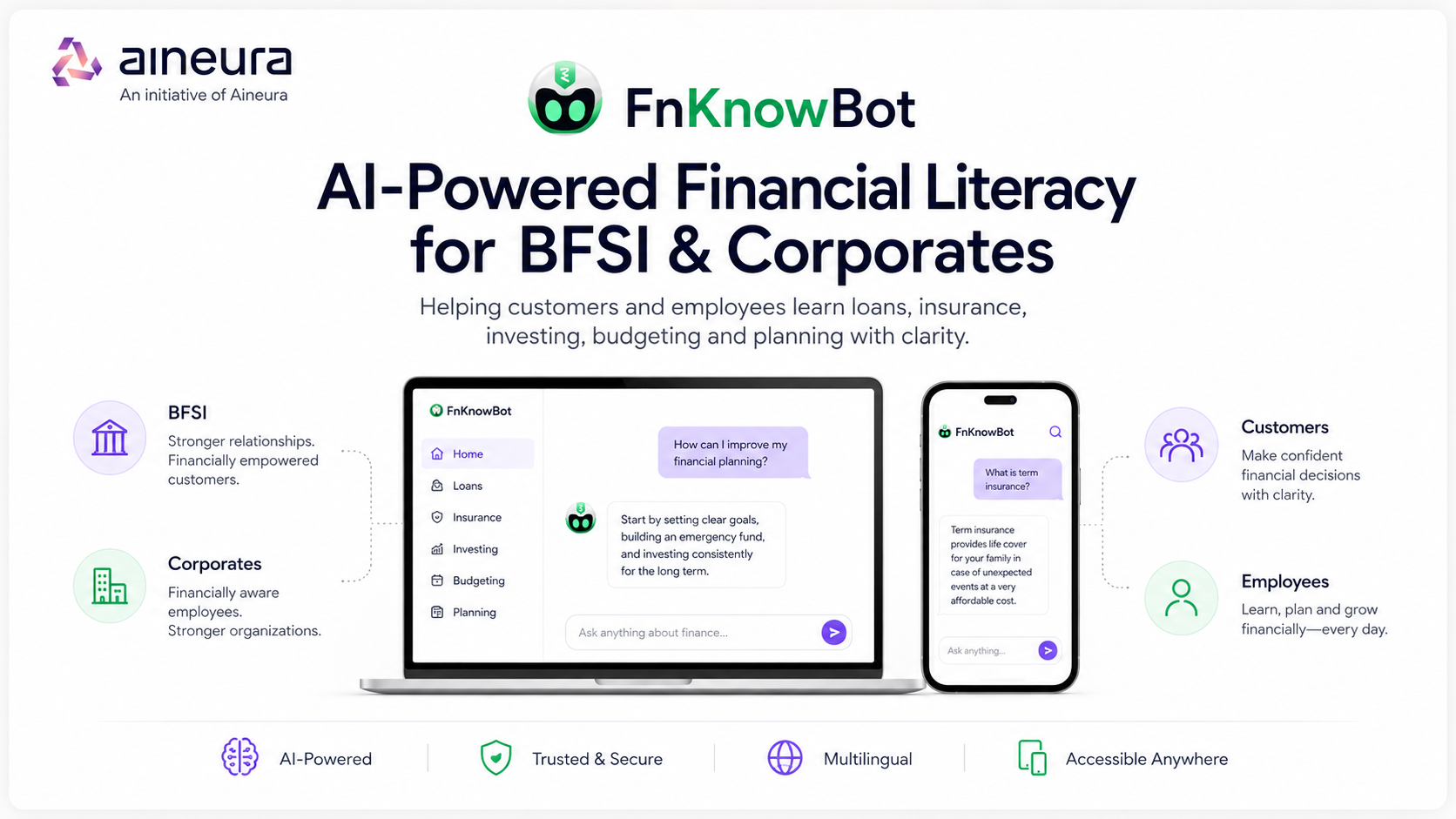
At Aineura , we have developed FnKnowBot , an AI-powered multilingual financial-learning platform supporting more than 15 Indian languages, in addition to major foreign languages.
FnKnowBot can be provided through a dedicated institutional link or integrated with existing websites, customer portals and applications. This enables BFSIs and corporates to create a scalable learning layer for customers, employees and families without building an entirely new platform from the beginning.
AI should complement—not replace—mandatory disclosures, regulated communication, professional advice, customer support or human judgement.
Better Understanding Can Reduce Conflict and Financial Harm
Clear and continuing financial education can help reduce:
- Unnecessary confusion and unrealistic expectations;
- Repayment stress and avoidable defaults;
- Customer grievances and allegations of mis-selling;
- Loss of savings or secured property;
- Strained relationships between institutions and customers;
- Avoidable disputes and litigation.
A financially informed customer is not a threat to an institution. Such a customer can become a more confident, responsible and sustainable participant in the financial ecosystem.
From Product Access to Responsible Participation
BFSIs and corporates should not measure financial inclusion only by the number of accounts opened, loans disbursed, policies sold or investment accounts activated.
Real inclusion requires people to understand the financial decisions they are making.
By combining institutional reach with AI-powered, multilingual and continuing financial learning, BFSIs and corporates can help build more informed customers, financially stronger employees and more resilient communities.
Explore AI-powered, multilingual and self-paced financial learning with FnKnowBot .
About the Author: Amit R Charan is the Founder of Aineura , an MSME-registered EdTech startup working in the financial-literacy space by leveraging artificial intelligence. He is an author and a corporate lawyer with close to two decades of professional experience in banking and finance. At Aineura, he is building FnKnowBot as an AI-powered multilingual personal-finance learning platform designed to make financial education more simplified, accessible and impactful for individuals, institutions and communities.