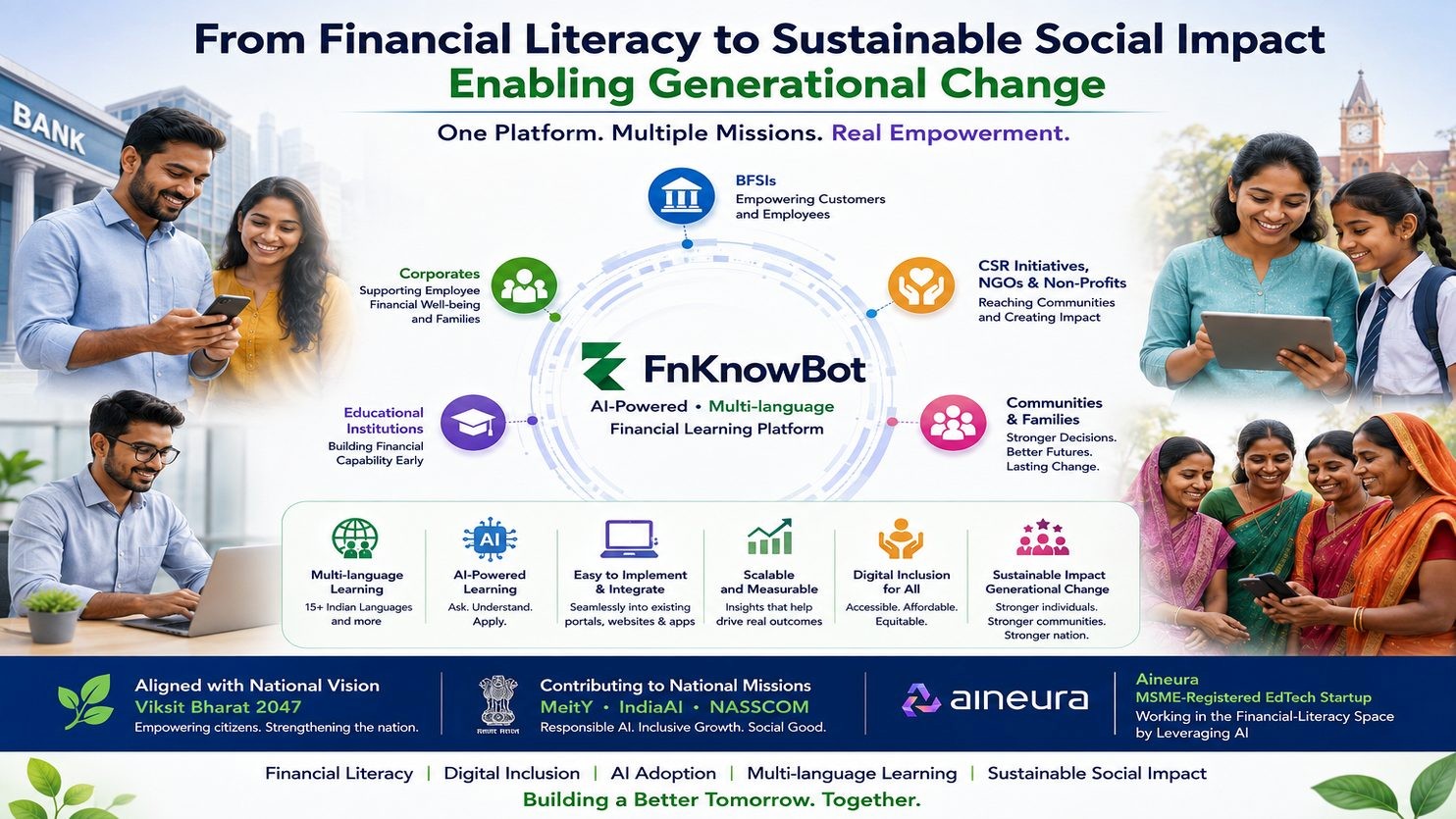
From Financial Literacy to Sustainable Social Impact: How Aineura and FnKnowBot Can Enable Generational Change
Building a scalable and inclusive financial-learning ecosystem for customers, employees, students, families and communities.
By: Amit R Charan , Founder, Aineura
Sustainable social impact is not created merely by reaching people once.
It is created when knowledge becomes understandable, remains accessible and gradually improves the way individuals and families make decisions.
Financial literacy has this potential. A better understanding of budgeting, savings, borrowing, insurance, investments, retirement planning and financial fraud can influence not only one transaction, but a lifetime of financial choices.
When practical financial understanding reaches customers, employees, students, entrepreneurs, families and communities, its impact can extend across generations.
Aineura is an MSME-registered EdTech startup working in the financial-literacy space by leveraging artificial intelligence. Through FnKnowBot , Aineura is working towards making personal finance learning more simplified, multilingual, interactive, self-paced and accessible.
The larger vision is to use financial literacy, digital inclusion and meaningful AI adoption to create true empowerment—at individual, institutional and community levels.
Financial Literacy as a Foundation for True Empowerment
Access to a bank account, financial product, salary, loan, insurance policy or investment application does not automatically create financial capability.
People must also understand:
- How to manage income and expenditure;
- Why emergency savings matter;
- When borrowing may become excessive;
- How insurance supports financial protection;
- How financial products and risks differ;
- How to identify financial fraud;
- How present decisions may affect long-term financial security.
True empowerment begins when people can understand these choices, ask relevant questions and participate more confidently in economic life.
This is why financial literacy should not be treated merely as an awareness activity. It should be developed as an ongoing capability that supports better-informed and more prudent decision-making.
From Individual Learning to Generational Change
Financial learning can create an influence that extends beyond the immediate learner.
An employee who understands budgeting, responsible borrowing and insurance may help improve household financial decisions. A student who learns about money early may approach their first salary, credit facility or investment with greater awareness. A parent who understands financial fraud may help protect other family members.
In this way, financial literacy can contribute to generational change.
Knowledge acquired by one individual can influence children, parents, spouses, colleagues and communities. Over time, stronger financial understanding may support more resilient households and more financially aware future generations.
One Platform, Multiple Institutional Pathways
Sustainable financial-literacy impact cannot be created only through individual subscriptions or isolated learning campaigns.
Institutions already have trusted relationships with customers, employees, students, staff, beneficiaries and communities. These institutional networks can become powerful channels for taking practical financial learning to a wider population.
FnKnowBot can support several institutional pathways through one adaptable learning platform.
BFSIs: Empowering Customers and Employees
Banks, NBFCs, insurers, stockbrokers, credit-card providers and other financial institutions interact with millions of people who regularly make decisions involving savings, loans, insurance, investments and financial risk.
FnKnowBot can support BFSIs in providing structured and multilingual financial learning to customers while also contributing to the financial well-being of employees.
Customers can explore financial topics, clarify terminology and understand general concepts before making important decisions. Employees can learn about budgeting, debt management, insurance, retirement planning, investments and financial well-being.
This can support customer education, employee engagement, responsible financial awareness and meaningful AI adoption within the institutional ecosystem.
Corporates: Supporting Employee Financial Well-Being
Financial concerns do not remain outside the workplace.
Debt, insufficient savings, insurance gaps, family responsibilities and retirement uncertainty can affect confidence, focus and overall employee well-being.
Corporates can provide FnKnowBot as a continuing financial-learning resource for employees. Because the platform is digital, multilingual and accessible beyond scheduled workshops, its learning value may also extend to employees’ families.
This creates a wider social-impact pathway—from employee financial wellness to stronger household financial awareness.
Educational Institutions: Building Financial Capability Early
Schools, colleges and universities offer an important opportunity to introduce financial literacy before young people begin earning, borrowing, investing or assuming major financial responsibilities.
Students can explore:
- Banking and digital payments;
- Budgeting and savings;
- Credit and responsible borrowing;
- Insurance and financial protection;
- Investing and financial risk;
- Fraud awareness;
- Long-term financial planning.
Educational institutions may also extend access to teachers, non-teaching staff and families.
Early financial awareness can help transform financial literacy from a corrective intervention in adulthood into a foundational life skill.
CSR Initiatives, NGOs and Non-Profits: Reaching Communities
CSR programmes, NGOs, foundations and non-profits can integrate financial learning into missions focused on:
- Women and SHG empowerment;
- Livelihoods and entrepreneurship;
- Youth and skill development;
- Rural and underserved communities;
- Digital inclusion;
- Financial-fraud awareness;
- Community resilience and financial well-being.
FnKnowBot can complement these programmes through facilitator-led learning, assisted individual access, self-paced mobile learning or shared access through digital kiosks and community devices.
AI does not replace community trust, facilitators or field experience. It can help organisations extend their reach, reduce repetitive manual explanation and provide learning continuity after a physical session has ended.
Breaking Language Barriers Through Multi-Language Learning
Financial knowledge becomes useful only when people can understand it.
A learner may be digitally connected but still remain excluded if explanations are available only in English or in complex financial terminology.
FnKnowBot supports more than 15 Indian languages, in addition to major foreign languages. This allows learners to explore personal finance in a language that feels natural, understandable and approachable.
Multi-language learning can help institutions:
- Reach learners across different regions;
- Reduce dependence on English-language content;
- Improve learner comfort and confidence;
- Support first-generation learners;
- Enable local-language facilitator-led programmes;
- Create wider and deeper programme penetration.
The purpose is not merely to translate financial words. It is to make financial learning understandable in the learner’s preferred or heart language.
From One-Time Awareness to Continuous Learning
Financial-literacy programmes have traditionally depended on workshops, classroom sessions, printed material or recorded videos.
These methods remain valuable, but sustainable social impact requires continuity after the session ends.
FnKnowBot enables learners to:
- Begin through structured pre-built questions;
- Ask direct questions through AI chat;
- Resolve doubts through follow-up queries;
- Revisit previous conversations through chat history;
- Create study notes for revision;
- Use quizzes to assess understanding;
- Learn through both text and video support;
- Continue at their own pace without continuous mentor dependency.
This transforms financial education from a one-time awareness intervention into a continuing learning journey.
Easily Implementable and Seamlessly Integrated
For technology to create meaningful impact, it should fit within the institution’s existing digital ecosystem.
FnKnowBot can be provided through a dedicated institutional link or integrated with existing websites, customer portals and mobile applications.
Depending on the partnership model, institutions can provide access to:
- Customers;
- Employees;
- Students;
- Teachers and staff;
- Beneficiaries;
- Families and community groups.
This enables institutions to introduce an AI-powered financial-learning layer without having to build and maintain an entirely new platform from the beginning.
The model combines institutional scale with individual learning relevance. One organisation may provide access to thousands of people, while every learner can explore different topics according to their needs, language, knowledge level and available time.
Scalable Social Impact With Reduced Manual Dependency
Traditional financial-literacy programmes often require repeated workshops, trainer travel, printed content and manual explanation across multiple locations.
AI-supported learning can help institutions extend the value of these efforts by providing:
- Consistent structured explanations;
- Immediate query resolution;
- Multi-language delivery through one platform;
- Self-paced learning beyond scheduled sessions;
- Reusable learning pathways across locations;
- Support for facilitators without extensive subject training;
- Wider reach with lower dependence on repeated manual delivery.
The objective is not to eliminate human involvement. It is to allow teachers, trainers and facilitators to focus on orientation, motivation, accessibility and difficult learner needs while the platform supports routine learning and clarification.
Meaningful AI Adoption and Digital Inclusion
AI adoption should not be measured only by the introduction of new technology.
It becomes meaningful when technology helps people understand essential knowledge, participate digitally and make better-informed decisions.
FnKnowBot brings together:
- Artificial intelligence;
- Financial literacy;
- Multi-language learning;
- Digital inclusion;
- Self-paced education;
- Institutional and community outreach.
This approach is directionally aligned with India’s broader goals around inclusive digital development, responsible AI adoption, citizen empowerment and the vision of Viksit Bharat.
It also reflects the wider impact-oriented direction encouraged across India’s technology ecosystem by institutions and industry bodies such as MeitY, IndiaAI and NASSCOM—using innovation to solve practical challenges and extend the benefits of technology to more people.
This represents alignment in purpose and direction and should not be interpreted as a claim of endorsement, affiliation or formal partnership with these organisations.
A Scalable Model With Global Relevance
Financial illiteracy and low financial confidence are global challenges.
People across countries need help understanding savings, credit, insurance, investments, retirement, fraud and financial risk. Products and regulations differ, but many foundational learning needs remain similar.
Because FnKnowBot is digital, multilingual and structured around adaptable financial topics, it can progressively be extended to other countries and institutional contexts.
Responsible international expansion would require localisation of:
- Financial terminology;
- Country-specific products;
- Tax and regulatory context;
- Consumer-protection information;
- Language and cultural presentation;
- Educational disclaimers and responsible-use boundaries.
The long-term opportunity is therefore not merely to translate an Indian platform. It is to build adaptable financial-learning infrastructure that can serve diverse learners across geographies.
Why This Matters for Social-Impact Investors
For social-impact investors, the opportunity is not simply the number of users who can access a digital platform.
The stronger impact thesis lies in whether technology can:
- Reach underserved learners;
- Break language and confidence barriers;
- Lower the cost of continuing education;
- Support institutional distribution;
- Extend human and facilitator effort;
- Encourage continued learner engagement;
- Create measurable participation and learning insights;
- Scale responsibly across communities and geographies;
- Contribute to long-term financial capability and generational change.
FnKnowBot operates at the intersection of financial literacy, AI adoption, digital inclusion, multi-language learning and sustainable social impact.
Its potential is both developmental and commercially sustainable: institutions gain access to a scalable financial-learning and engagement platform, while individuals gain practical knowledge that can strengthen personal, household and community decision-making.
From Access to Lasting Empowerment
Technology alone cannot guarantee social impact.
Impact emerges when technology is thoughtfully combined with institutional reach, human trust, practical knowledge and continued learner participation.
Through FnKnowBot, Aineura is working towards an ecosystem in which BFSIs, corporates, educational institutions, CSR programmes, NGOs and non-profits can become partners in making financial learning more accessible.
The objective is not merely to reach more people.
It is to help customers, employees, students, families and communities understand financial choices, develop greater confidence and participate more meaningfully in economic life.
Explore AI-powered, multilingual and self-paced financial learning with FnKnowBot .
About the Author: Amit R Charan is the Founder of Aineura , an MSME-registered EdTech startup working in the financial-literacy space by leveraging artificial intelligence. He is an author and a corporate lawyer with close to two decades of professional experience in banking and finance. At Aineura, he is building FnKnowBot as an AI-powered multilingual personal finance learning platform designed to make financial education more simplified, accessible, inclusive and impactful for individuals, institutions and communities.