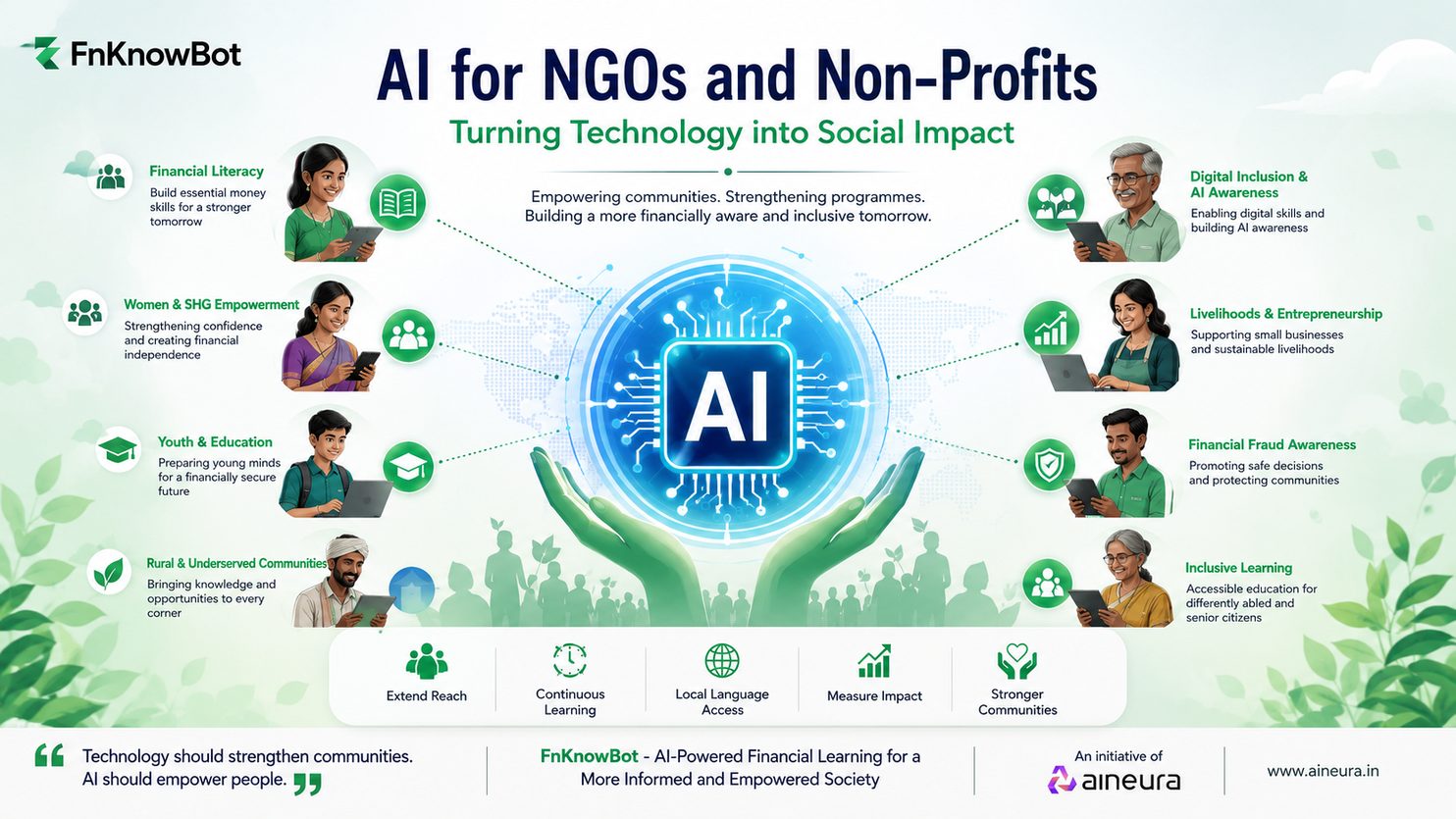
AI for NGOs and Non-Profits: Turning Technology into Social Impact
By: Amit R Charan , Founder, Aineura
I often receive enquiries about how NGOs, non-profits, foundations and CSR programmes can use artificial intelligence meaningfully.
The question is understandable. AI is receiving enormous attention, but social-impact organisations do not need technology merely for the sake of appearing technologically advanced.
They need technology that helps them serve people better.
For NGOs and non-profits, meaningful AI adoption should therefore begin with a practical question: Can this technology improve access, understanding, continuity, inclusion or programme effectiveness for the communities we serve?
When the answer is yes, AI can become far more than an organisational trend. It can become a tool for extending human effort, strengthening programme delivery and making essential knowledge more accessible.
The Real Opportunity Is Not “AI Adoption”
The real opportunity is not simply to introduce an AI chatbot, add automation to a website or announce that an organisation has become “AI-enabled.”
The opportunity is to use AI to address long-standing programme challenges such as:
- Limited access to subject-matter experts;
- Language barriers;
- Dependence on repeated workshops;
- Difficulty providing support between field visits;
- Inconsistent explanations across locations;
- Limited trainer capacity;
- Low learner confidence;
- Weak continuity after programme sessions end.
AI becomes useful when it helps solve one or more of these real constraints.
Technology should therefore follow the mission—not redefine it.
NGOs Already Possess What Technology Cannot Easily Create
NGOs and community organisations already possess some of the most valuable elements of social impact:
- Trust within communities;
- Understanding of local realities;
- Relationships with beneficiaries;
- Knowledge of cultural and social barriers;
- Field experience;
- Human empathy and contextual judgement.
AI cannot easily manufacture these qualities.
It should strengthen them.
The most effective model is therefore not technology replacing field teams. It is technology helping field teams reach more people, answer more questions, provide more consistent support and continue engagement beyond scheduled interactions.
A Problem-First Approach to AI
Before selecting any AI tool, an organisation should identify the problem it is trying to solve.
For example:
- Are beneficiaries unable to access learning after a workshop?
- Do learners hesitate to ask basic questions?
- Are trainers repeating the same explanations across many groups?
- Is content available only in English?
- Do field teams require a simple way to explain difficult concepts?
- Is the programme struggling to serve multiple locations consistently?
- Do beneficiaries need ongoing support between physical sessions?
Once the problem is clearly defined, the organisation can assess whether AI is the right tool—and what kind of AI support is actually required.
Not every programme needs a complex custom-built AI system. In many cases, a focused platform designed for a specific learning or service need may be more useful, affordable and easier to implement.
Where AI Can Add Meaningful Value
1. Making Knowledge Available on Demand
Traditional programme delivery often depends on scheduled sessions, trainer availability and physical presence.
AI-supported learning can remain available after a workshop has ended. Beneficiaries can return to a topic, ask another question or revisit an explanation when they are ready.
This can turn a one-time awareness activity into a continuing learning opportunity.
2. Supporting Multilingual Inclusion
Many beneficiaries may be digitally connected but still excluded from useful knowledge because the content is available only in English or in highly technical language.
Multilingual AI can help programmes provide explanations in the learner’s preferred language.
Language access is not merely a translation feature. It can improve comfort, participation and the willingness to ask questions.
3. Reducing Repetitive Manual Explanation
Field teams and facilitators may repeatedly explain the same foundational concepts to different groups.
An AI-supported platform can provide structured explanations, guided questions and follow-up clarification, allowing facilitators to focus on discussion, motivation and local context.
This does not remove the facilitator. It helps the facilitator use time more effectively.
4. Enabling Self-Paced Learning
Beneficiaries do not learn at the same speed.
Some may understand a concept during the first explanation. Others may need to revisit it several times, ask follow-up questions or learn through a different format.
Self-paced learning allows people to continue without the pressure of keeping up with a group.
5. Extending Programme Reach
A digital platform can be used across multiple locations without requiring a specialist trainer to travel to every beneficiary group.
It can support individual access, facilitator-led sessions and shared access through community devices or digital points.
This can help organisations move from isolated interventions toward wider and more continuous programme coverage.
6. Supporting Better Programme Insight
Digital learning systems can help organisations understand which topics are being explored, which languages are preferred and where learners may need further support.
These indicators should not be confused with final social outcomes, but they can help improve programme design and identify learning gaps.
AI Should Strengthen the Human Layer
Social-impact work often involves complex human circumstances.
A beneficiary may have limited literacy, low digital confidence, accessibility requirements, family pressures or financial difficulties that cannot be understood through technology alone.
Human support therefore remains essential for:
- Building trust;
- Understanding personal circumstances;
- Encouraging participation;
- Supporting low-literacy learners;
- Managing sensitive situations;
- Providing empathy and judgement.
The stronger model is therefore:
AI can provide scale and continuity. Community organisations provide context, trust and human connection.
Avoiding Technology That Creates New Exclusion
AI should not create additional barriers for the people it is intended to serve.
A platform may be technically sophisticated but still unsuitable if it requires:
- Advanced prompt-writing skills;
- High English proficiency;
- Expensive devices;
- Continuous high-speed connectivity;
- Complex navigation;
- Extensive trainer certification;
- Multiple paid subscriptions.
For community use, AI should be simple enough to approach, flexible enough to deploy and focused enough to support the programme’s actual purpose.
Responsible AI Is Essential
The use of AI in social-impact programmes requires responsibility.
Organisations should examine:
- Whether the content is accurate and appropriate;
- How beneficiary data is handled;
- Whether users understand the limits of AI-generated responses;
- Whether personalised professional advice is being distinguished from education;
- Whether vulnerable users have access to human support;
- Whether the platform is accessible and inclusive;
- Whether the technology supports rather than manipulates beneficiaries.
Responsible AI adoption is not only a technical matter. It is part of programme governance.
What NGOs Should Ask Before Adopting an AI Platform
Before implementation, an organisation should consider:
- Problem fit: What programme problem will the platform solve?
- Beneficiary fit: Is the platform suitable for the literacy, language and digital familiarity of the target group?
- Delivery fit: Can it be used individually, through facilitators or on shared devices?
- Content fit: Does it provide relevant and structured learning?
- Cost fit: Can the programme sustain the technology beyond a short pilot?
- Governance fit: Are data protection, accountability and human oversight clear?
- Impact fit: What indicators will show whether the technology is being used meaningfully?
A clear answer to these questions can prevent technology from becoming an isolated add-on with little programme value.
Financial Learning as One Practical Use Case
Financial literacy is one area where AI can support social-impact programmes in a practical manner.
Money-related understanding is relevant across women’s empowerment, livelihoods, entrepreneurship, youth development, employee well-being, rural outreach and digital inclusion.
People may need help understanding:
- Budgeting and savings;
- Loans and responsible borrowing;
- Insurance and financial risk;
- Digital payments and fraud awareness;
- Investments and long-term planning;
- Retirement and financial well-being;
- Entrepreneurial cash flow and financial discipline.
These subjects can be difficult to address through one-time workshops alone, especially across different languages and levels of prior knowledge.
Where FnKnowBot Fits
At Aineura , we have developed FnKnowBot , an AI-powered multilingual financial-learning platform.
FnKnowBot is designed to make personal finance learning more structured, approachable and self-paced through:
- Pre-built questions that reduce prompt anxiety;
- Direct AI chat and follow-up queries;
- Simplified explanations;
- Support for more than 15 Indian languages and major foreign languages;
- Structured financial topics and subtopics;
- Chat history and study notes;
- Quizzes and video-supported learning;
- Access through mobile, laptop, tablet or shared digital points.
The platform can complement financial-literacy, community-development and digital-inclusion programmes without requiring every facilitator to become a financial subject-matter expert.
Its role is not to replace community organisations or professional advice. It is to provide a structured learning layer that can support wider access, continuity and multilingual participation.
From Technology Deployment to Social Value
A successful AI initiative should not be measured only by the number of accounts created, devices installed or queries generated.
The more meaningful questions are:
- Did more people gain access to useful knowledge?
- Were learners able to understand concepts in their preferred language?
- Did beneficiaries continue learning after the initial session?
- Did facilitators become more effective?
- Were previously hesitant learners able to ask questions?
- Did the programme extend to locations that were earlier difficult to serve?
These are the outcomes through which technology begins to create social value.
The Way Forward
NGOs and non-profits do not need to become technology companies.
They need access to responsible technology that strengthens their mission.
AI can help make learning more available, multilingual, responsive and continuous. It can support facilitators, reduce repetitive work and help organisations extend their reach.
But its value will ultimately depend on how thoughtfully it is integrated into the programme and how well it responds to the realities of the people being served.
Explore AI-powered multilingual financial learning with FnKnowBot .
About the Author: Amit R Charan is the Founder of Aineura , an author and a corporate lawyer. At Aineura, he is building FnKnowBot as an AI-powered multilingual personal finance learning platform designed to make financial education more simplified, accessible and impactful for individuals, institutions and communities.