How AI Can Reduce Hesitation in Learning—and Lower Learner Drop-Off
How guided questions, multilingual access, instant clarification and self-paced learning can help more people begin—and continue—their financial-learning journey.
By: Amit R Charan , Founder, Aineura
Many people do not discontinue learning because they lack intelligence, curiosity or willingness.
They disengage because the learning experience makes them feel confused, embarrassed, overwhelmed or left behind.
A learner may hesitate to ask what appears to be a basic question. Another may struggle with technical terminology. Someone else may not understand enough about the subject to know what question should be asked first.
When these early barriers remain unresolved, hesitation can gradually become disengagement. The learner pauses, postpones or quietly abandons the learning journey.
This is particularly visible in financial education, where subjects can feel personal, technical and intimidating. Questions about savings, loans, insurance, debt, investments, retirement or financial mistakes may make people feel exposed or uncomfortable.
Artificial intelligence can help redesign this experience by making learning more private, conversational, guided, multilingual, self-paced and available whenever confusion arises.
Hesitation Is an Invisible Learning Barrier
Traditional discussions about learner drop-off often focus on course difficulty, lack of time, limited access or inadequate motivation.
These factors are important, but there is another barrier that is less visible: the learner may not feel comfortable admitting what they do not understand.
This hesitation may arise from:
- Fear of being judged for asking a basic question;
- Embarrassment about limited financial knowledge;
- Discomfort with English or technical terminology;
- Anxiety about speaking in front of a group;
- Uncertainty about how to frame a question;
- Lack of access to a patient mentor;
- Previous negative learning experiences;
- Feeling that everyone else already understands the subject.
The learner may remain present in a workshop, video session or online course while mentally disengaging because an important doubt has not been resolved.
Learning drop-off can therefore begin long before someone formally leaves a course. It may begin at the moment a learner decides not to ask.
Why Financial Learning Creates Additional Anxiety
Money is closely connected with income, family responsibility, social status, security and personal mistakes.
A student may hesitate to admit that they do not understand how a bank account works. An employee may feel embarrassed about not knowing how taxation, insurance or retirement planning operates. A borrower may be uncomfortable discussing debt. A new investor may pretend to understand financial terminology rather than reveal confusion.
The subject itself may also appear complex because it includes unfamiliar expressions such as:
- Credit score;
- Compound interest;
- Asset allocation;
- Deductible;
- Diversification;
- Expense ratio;
- Loan amortisation;
- Risk-adjusted return.
A learner may recognise these words without confidently understanding their practical meaning.
The result is a gap between access to information and actual understanding.
AI Can Make the First Question Easier
One of the strongest advantages of AI-assisted learning is that the learner can begin privately.
There is no classroom audience, no fear of interrupting a trainer and no embarrassment about requesting the same explanation again.
The learner can ask:
- What is a household budget?
- Why do I need an emergency fund?
- How does a loan EMI work?
- What happens if I pay only the minimum amount on my credit card?
- What is the difference between saving and investing?
- How can I recognise a financial scam?
- Why is insurance important?
- How should I begin planning for retirement?
The learner can then request a simpler explanation, ask for an example or continue through follow-up questions.
This creates a more patient learning environment in which curiosity is not limited by embarrassment.
The Blank-Screen Problem
Many general AI tools begin with an empty chat box.
For an experienced user, this provides freedom. For a first-time learner, it may create another form of anxiety.
Someone unfamiliar with personal finance may not know:
- Which topic to begin with;
- What question should be asked;
- Which terminology is correct;
- How much information should be included;
- Whether the question is relevant;
- What should be learned next.
It is not reasonable to expect financially inexperienced learners to first become skilled at creating AI prompts before they can begin learning.
A learning platform should reduce the burden of asking—not add another test before learning can start.
Pre-Built Questions Can Reduce Prompt Anxiety
Pre-built questions are therefore not merely a convenience. They are an important inclusion feature.
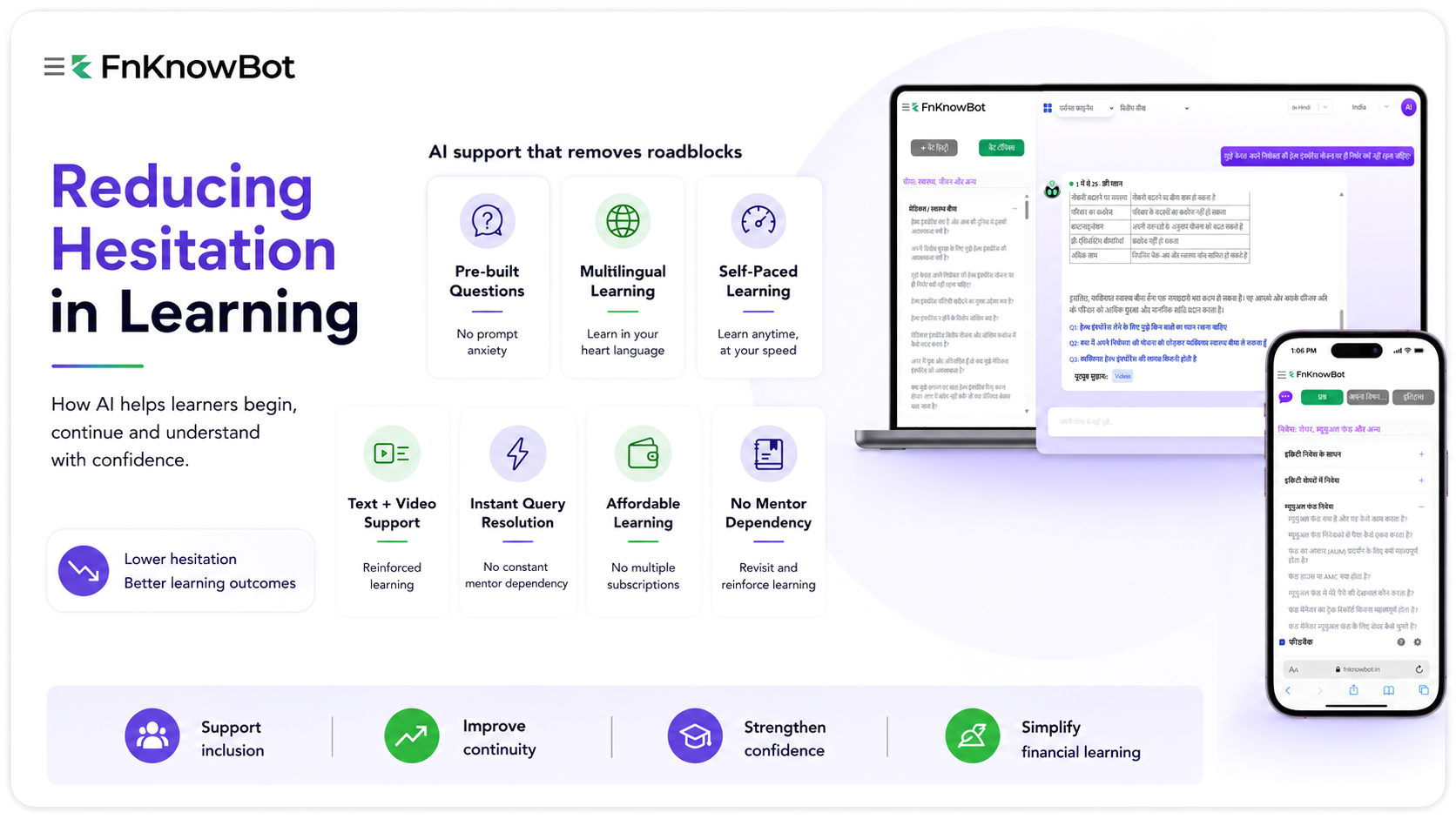
FnKnowBot organises financial learning into topics, subtopics and guided questions. A learner can begin by selecting a relevant question instead of having to formulate one independently.
For example, someone exploring loans may begin with a question about interest, EMI or repayment. A person learning about insurance may select a question about premiums, coverage or exclusions. A new investor may begin with foundational questions before moving towards products, markets or risk.
Pre-built questions can help learners:
- Begin without prompt-writing skills;
- Discover questions they did not know they should ask;
- Follow a more structured learning journey;
- Reduce anxiety about incorrect terminology;
- Move gradually from foundational to advanced concepts;
- Develop confidence before asking independent questions.
The learner begins with guidance and can later move towards greater curiosity and independent exploration.
From Guided Questions to Independent Curiosity
A well-designed guided question should not end the learning process. It should encourage the next question.
After reading an explanation, the learner may ask:
- Can you explain this more simply?
- Can you give me an example?
- What is the difference between these two concepts?
- What risks should I understand?
- Why does this matter in everyday life?
- What should I learn after this?
This movement from a pre-built question to an independent follow-up question is important.
It reflects a change in the learner—from uncertainty towards participation.
Quick Clarification Can Prevent Learner Drop-Off
A small unresolved doubt can become a larger learning barrier.
A learner who does not understand interest may struggle with loans and credit cards. Someone who is unclear about financial risk may misunderstand investments. A person who does not recognise the difference between insurance and investment may develop incorrect expectations.
In a conventional learning programme, the learner may have to wait for the next workshop, trainer interaction or scheduled session.
An AI-supported platform can address the doubt when it arises.
The learner can:
- Ask a direct chat question;
- Select a related pre-built question;
- Request a simpler explanation;
- Ask for a practical example;
- Continue with follow-up questions;
- Explore a connected topic immediately.
Immediate clarification helps preserve learning momentum. It prevents confusion from accumulating and reduces the possibility that the learner will quietly disengage.
Self-Paced Learning Respects Different Learning Speeds
Not every learner understands a concept at the same speed.
Some people may understand an explanation immediately. Others may need to read it again, see another example, watch a supporting video or return to the subject after a few days.
Self-paced learning allows the learner to:
- Begin at their existing level of understanding;
- Pause without feeling left behind;
- Revisit explanations;
- Learn one topic at a time;
- Continue according to personal availability;
- Ask the same question in another way;
- Progress without pressure from a group.
This is especially useful for students, working individuals, homemakers, senior citizens, entrepreneurs and people with limited previous exposure to personal finance.
A workshop must end at a scheduled time. A self-paced learning platform can remain available when the learner is ready to continue.
Reinforced Learning Through Repetition and Review
Learning is rarely completed through one explanation.
Understanding grows when a learner can revisit a concept, examine it from another angle and connect it with related ideas.
FnKnowBot can support reinforced learning through several connected features.
Chat History
Learners can return to earlier conversations instead of beginning again each time. Reviewing earlier questions and explanations can refresh understanding and maintain continuity.
Study Notes
Important concepts can be organised into study notes. This helps convert a conversational exchange into a reusable resource for revision and future reference.
Follow-Up Questions
A learner can immediately clarify a doubt arising from the first explanation instead of carrying an incomplete understanding into the next topic.
Quizzes
Short quizzes can help learners test their understanding and identify concepts that may require further review.
Video-Supported Learning
Financial learning need not remain text-heavy. Supporting videos can provide visual explanations, demonstrations and examples for learners who engage more comfortably through audiovisual content.
This reinforced approach can improve continuity and reduce the possibility that the learner will forget, misunderstand or abandon the subject after one interaction.
Learning in the Learner’s Heart Language
Language affects more than access. It affects confidence, comfort and comprehension.
A person may understand conversational English but still struggle to learn financial concepts through English terminology.
The same explanation may feel far more approachable when delivered in the language used at home, within the community or in everyday thinking.
FnKnowBot supports more than 15 Indian languages in addition to major foreign languages. This multilingual capability can make financial learning:
- Easier to approach;
- Simpler to understand;
- More comfortable for first-time learners;
- Relevant across regions and communities;
- Less dependent on English fluency;
- Suitable for wider institutional and social-impact programmes.
The objective is not merely to translate words. It is to explain financial ideas in the learner’s heart language—the language in which understanding feels natural and questions are easier to ask.
Less Mentor-Dependent, Not Human-Free
Human mentors, teachers and facilitators remain valuable.
They can motivate learners, understand local circumstances, guide group discussions and support people with limited literacy, accessibility requirements or low digital confidence.
However, a learning programme should not depend on a subject-matter expert being available for every question.
An AI-supported platform can provide:
- Structured learning pathways;
- Consistent explanations;
- Pre-built questions;
- Instant query resolution;
- Follow-up clarification;
- Multilingual access;
- Study notes, quizzes and videos;
- Availability beyond scheduled sessions.
This allows facilitators to focus on orientation, motivation, discussion and learners requiring additional assistance.
AI does not need to replace the mentor. It can reduce continuous mentor dependency and extend the mentor’s reach.
Supporting Facilitators Without Heavy Subject Training
NGOs, non-profits, CSR programmes and community organisations may work through field facilitators who understand the community but are not specialist financial trainers.
Requiring every facilitator to undergo extensive subject-matter training can make programmes expensive, slow and difficult to scale.
After receiving basic orientation on navigation, language selection, learning modules and pre-built questions, a facilitator can use FnKnowBot through a mobile phone, tablet or laptop.
The facilitator can:
- Select programme-relevant questions;
- Display or explain answers to a group;
- Ask follow-up questions on behalf of participants;
- Use supporting videos;
- Conduct quizzes;
- Help learners revisit difficult concepts.
The platform can therefore support facilitators without requiring every person conducting a workshop to become a financial subject-matter expert.
Reaching Learners Without Personal Digital Devices
Digital inclusion should not require every beneficiary to own a personal smartphone, laptop or tablet.
Where individual device access is limited:
- A facilitator can conduct a group session through one mobile phone, tablet or laptop;
- An SHG leader can guide members through selected questions;
- A community centre can provide shared computer access;
- A digital kiosk can operate as a financial-learning point;
- A mobile learning van or bus can carry devices to multiple locations;
- Public digital points can provide embedded access to the platform.
One shared device can therefore support several learners.
This is particularly relevant for communities with limited device ownership, lower literacy or low digital familiarity.
Who Can Benefit From Learning Without Hesitation?
Students and Young Adults
They can ask foundational questions about banking, budgeting, salaries, credit, insurance and investing before making important financial decisions.
Employees
They can privately explore taxation, debt, insurance, emergency funds, retirement planning and long-term savings.
Women and SHG Members
They can learn about budgeting, savings, responsible borrowing, insurance, fraud awareness and financial independence in a comfortable language.
Senior Citizens
They can learn at a comfortable pace, revisit explanations and explore digital-finance or fraud-related questions without being rushed.
New Investors
They can build foundational understanding before exploring financial products, market risks or more advanced concepts.
Entrepreneurs and Self-Employed Individuals
They can explore cash flow, borrowing, insurance, risk management and the separation of household and business finances.
Rural and Underserved Communities
They can access guided multilingual learning through facilitators, shared devices, community centres or digital kiosks.
How FnKnowBot Fits Into This Vision
FnKnowBot , developed by Aineura , is designed around the principle that financial learning should be approachable before it becomes advanced.
Its combination of AI chat, structured topics, pre-built questions, multilingual explanations, follow-up queries, chat history, study notes, quizzes and video-supported content can help learners begin without already knowing what to ask.
The platform supports learning across:
- Budgeting and savings;
- Banking, loans and credit;
- Insurance;
- Investments and mutual funds;
- Stock-market learning;
- Retirement planning;
- Real estate and financial planning;
- Financial well-being;
- Fraud and digital-safety awareness.
For individual learners, FnKnowBot can provide privacy, flexibility and continuity.
For institutions and community programmes, it can offer a guided learning layer that supports facilitators, shared-device access, multilingual delivery and wider programme reach.
From Information Access to Learning Continuity
The challenge of financial education cannot be solved merely by publishing more articles, organising more workshops or producing more videos.
People also need a learning environment in which they feel comfortable beginning—and continuing.
They need:
- Permission to ask basic questions;
- Guidance when they do not know what to ask;
- Immediate clarification when confusion arises;
- Explanations in a language they understand;
- The ability to revisit earlier learning;
- Text, chat, notes, quizzes and videos working together;
- Human support without permanent mentor dependency;
- The freedom to learn at their own pace.
When hesitation is reduced, questions emerge.
When questions emerge, understanding can begin.
When learners can clarify, revisit and continue without embarrassment, learning drop-off may be reduced.
Explore simplified, multilingual and self-paced financial learning with FnKnowBot .
About the Author: Amit R Charan is the Founder of Aineura , an author, and a corporate lawyer. At Aineura, he is building FnKnowBot as a comprehensive personal finance learning platform leveraging AI to make financial literacy simplified, accessible, interesting and impactful—for sustainable social impact in India and beyond.