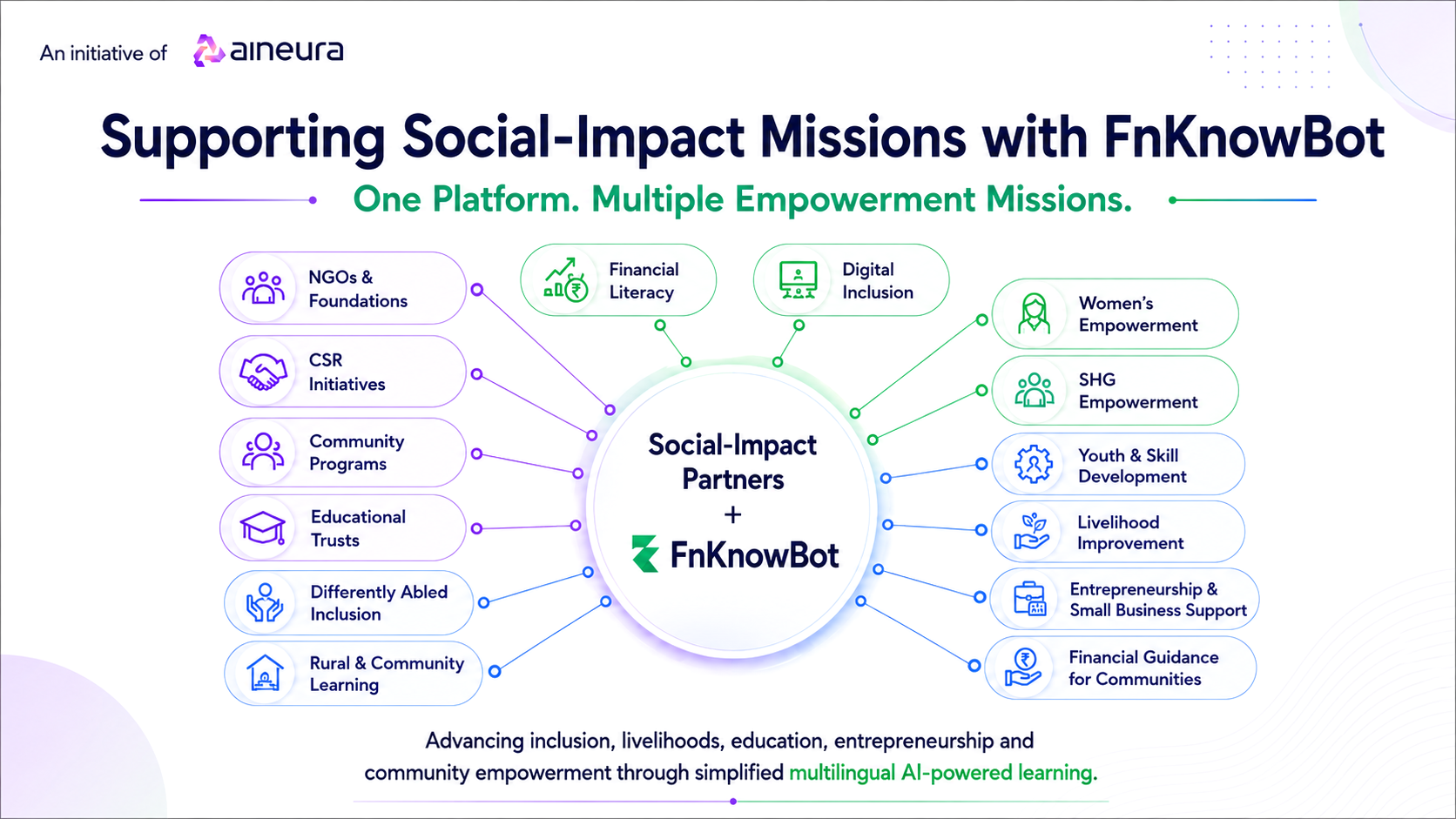
One Platform, Multiple Missions: How FnKnowBot Can Support Community Empowerment
By: Amit R Charan , Founder, Aineura
Community-development programmes may be created around different objectives. Some focus on financial literacy. Others work toward women’s empowerment, livelihood development, entrepreneurship, digital inclusion, youth skilling, rural outreach or economic participation.
Although these missions may appear different, many of them share a common underlying requirement: people need practical financial understanding to participate more confidently in economic life.
A livelihood initiative may help a participant begin earning, but that income must still be budgeted and managed. An entrepreneurship programme may help someone start a small business, but the entrepreneur must understand borrowing, cash flow, insurance and financial risk. A women’s empowerment programme may promote economic independence, but its long-term impact can be strengthened when participants understand savings, credit, fraud prevention and financial planning.
Financial learning, therefore, need not remain a separate or isolated social-impact activity. It can become an enabling layer across multiple community-development missions.
This is where FnKnowBot , Aineura’s AI-powered multilingual financial-learning platform, can support different initiatives through one flexible learning solution.
Financial Understanding as an Empowerment Tool
Community empowerment is not achieved only by providing access to services, technology, credit, employment or income-generating opportunities. People must also be able to understand the choices, responsibilities and risks connected with those opportunities.
Consider some everyday situations:
• A first-time borrower may receive access to credit but may not fully understand interest, repayment obligations or the consequences of over-borrowing.
• A worker may earn regularly but remain financially vulnerable without emergency savings or suitable insurance.
• A small entrepreneur may generate revenue but struggle to separate household expenditure from business cash flow.
• A new investor may know about financial products but may not understand risk, suitability or diversification.
• A digitally connected user may use payment applications but remain exposed to scams and financial fraud.
These are not merely financial-product issues. They are learning and capability issues.
When practical financial understanding is incorporated into a broader community programme, beneficiaries may become better equipped to evaluate options, ask informed questions and make more prudent decisions.
Why One Learning Platform Can Support Multiple Missions
The foundational principles of money management remain relevant across many beneficiary groups. Budgeting, savings, responsible borrowing, insurance, risk awareness and financial fraud prevention may be useful to a student, an employee, a rural household, a self-help group member or a first-generation entrepreneur.
The learner’s circumstances may differ, but the core knowledge can be organised into suitable learning pathways for different programmes.
A common platform can therefore provide a reusable financial-learning foundation while allowing institutions to emphasise topics relevant to their own missions.
For example:
• A women’s empowerment programme may prioritise household budgeting, savings, insurance, credit and financial independence.
• A livelihood programme may focus on income management, borrowing, cash flow and financial risk.
• A youth programme may begin with banking, budgeting, digital payments and responsible credit use.
• A rural outreach initiative may emphasise savings, insurance, formal borrowing and fraud awareness.
• An entrepreneurship programme may cover working capital, debt management, business risk and prudent financial planning.
This flexibility allows financial learning to complement an existing programme instead of requiring the organisation to create a completely separate education initiative.
How FnKnowBot Supports Practical Learning
FnKnowBot is being developed to make personal finance learning simplified, interactive, multilingual and self-paced.
Instead of expecting every learner to know what to type into an open AI chatbot, FnKnowBot provides structured financial topics and guided, pre-built questions. A learner can select a topic, begin with a suggested question, read an explanation and continue with follow-up queries.
The platform can support learning through:
• Structured personal-finance categories and subtopics;
• Pre-built questions for guided, one-click learning;
• AI chat for specific learner queries;
• Instant explanations and follow-up questions;
• Simplified treatment of financial terminology;
• Multilingual learning in the user’s preferred language;
• Study notes and AI-generated learning summaries;
• Quizzes for assessing understanding;
• Mobile, web and shared-kiosk access;
• Self-paced availability without continuous trainer dependency.
This combination is particularly relevant for community learning because beneficiaries may have different levels of education, confidence, digital familiarity and prior financial knowledge.
A learner who is hesitant to formulate a question can begin with a pre-built option. Another learner can type a specific query. A facilitator can guide a group through selected topics, while an independent user can explore the platform privately and at a convenient pace.
1. Financial-Literacy Programmes
Financial-literacy initiatives often need to cover a wide spectrum of money-related subjects without overwhelming the learner.
FnKnowBot can support learning across budgeting, savings, banking, loans, credit cards, insurance, investments, retirement planning, financial well-being, financial planning and fraud awareness.
Its structured learning approach can help beneficiaries progress from foundational concepts toward more detailed questions. The objective is not only to present information, but to help learners understand why a financial concept matters and how it may relate to everyday decisions.
2. Women and Self-Help Group Empowerment
Women’s empowerment and self-help group programmes frequently involve savings, collective financial activity, livelihood development, credit access and household money management.
Financial learning can strengthen these initiatives by supporting awareness of:
• Household and personal budgeting;
• Regular savings and emergency funds;
• Responsible borrowing and repayment planning;
• Insurance and financial-risk protection;
• Digital payments and fraud awareness;
• Financial independence and long-term planning.
FnKnowBot can be used within facilitator-led SHG sessions, while individual participants may also continue exploring topics independently after the group interaction.
Learning in a preferred language can be especially important in helping participants engage with financial concepts without feeling restricted by English terminology or technical jargon.
3. Digital-Inclusion Initiatives
Digital inclusion should extend beyond providing devices, connectivity or access to applications. Meaningful digital inclusion enables people to use technology for learning, decision-making and economic participation.
An AI-powered learning platform can introduce users not only to financial concepts, but also to a practical and responsible use of artificial intelligence.
Through guided questions and conversational interaction, beneficiaries can experience how AI may be used to clarify concepts, explore topics and support self-learning.
FnKnowBot can therefore contribute to two connected objectives:
• Improving financial understanding; and
• Promoting meaningful AI and digital adoption.
Depending on the programme and available infrastructure, access may be offered through personal mobile devices, shared tablets, community centres or digital kiosks.
4. Rural and Underserved Communities
Rural and underserved communities may face several overlapping barriers to financial learning: limited availability of trainers, language constraints, travel requirements, complex terminology and irregular access to structured educational programmes.
A multilingual, self-paced platform can complement field-based programmes by making learning available beyond a single workshop or awareness camp.
Beneficiaries may revisit topics, ask additional questions and continue learning according to their own requirements. Facilitators can also use selected questions and explanations during group discussions.
The platform does not replace the valuable role of community organisations or field facilitators. Instead, it can provide them with an additional learning resource that remains available between and after physical sessions.
5. Youth and Skill-Development Programmes
Financial awareness is an important life skill for young people preparing for employment, entrepreneurship or independent economic life.
Many young learners begin using digital payments, bank accounts, credit facilities and investment applications without receiving structured financial education.
Youth and skilling programmes can incorporate foundational learning on:
• Managing the first salary or income;
• Creating a practical budget;
• Building an emergency fund;
• Understanding credit and debt;
• Evaluating insurance needs;
• Recognising financial fraud;
• Beginning long-term saving and investing with risk awareness.
Self-paced AI-assisted learning can also encourage young users to ask questions they may hesitate to raise in a classroom or group environment.
6. Livelihood and Entrepreneurship Missions
Income generation is an important beginning, but the sustainability of a livelihood also depends on how income, expenditure, credit and financial risk are managed.
A micro-entrepreneur or self-employed participant may need to understand the difference between revenue and profit, household and business expenses, productive and excessive borrowing, short-term cash requirements and long-term financial resilience.
FnKnowBot can complement entrepreneurship and livelihood training by supporting learning related to:
• Personal and business cash-flow awareness;
• Borrowing and repayment planning;
• Emergency reserves;
• Insurance and risk protection;
• Separation of household and business finances;
• Prudent use of profits and surplus income;
• Financial fraud and digital-payment awareness.
Such learning can strengthen the financial dimension of programmes that primarily focus on vocational skills, market access or income generation.
7. Financial Well-Being and Community Resilience
Financial difficulty can affect not only household resources but also confidence, relationships, health and the ability to plan for the future.
Community programmes may therefore benefit from approaching financial literacy as part of broader financial well-being and resilience.
Learning about emergency planning, debt discipline, insurance, savings and fraud awareness can help participants understand how financial preparedness may reduce vulnerability during unexpected events.
This does not guarantee particular financial outcomes. It helps build the knowledge base from which more informed and prudent decisions may be made.
Flexible Deployment for Different Community Settings
Community programmes are not implemented in one uniform manner. Some organisations work through field facilitators, others through self-help groups, training centres, schools, digital labs or direct beneficiary access.
FnKnowBot can be aligned with three broad usage models:
Facilitator-Led or SHG Learning
A facilitator can use selected topics and guided questions during group sessions. Participants can discuss the explanations, complete quizzes and continue learning independently where access is available.
Direct Individual Access
Digitally comfortable beneficiaries can access FnKnowBot through their mobile phone or web browser and learn privately at their own pace.
Shared Digital Kiosks
Community centres, digital-literacy facilities, educational institutions or programme locations can provide shared access through kiosks, computers or tablets.
These models may also be combined. A programme might begin with facilitator-led orientation, provide shared access during field sessions and enable direct access for beneficiaries who have suitable devices.
Aligning FnKnowBot With Existing Programmes
NGOs, foundations and CSR teams may already have established beneficiary groups, facilitators, implementation partners and programme objectives.
FnKnowBot need not displace these systems. It can be introduced as a technology and learning layer within the existing programme structure.
Depending on the initiative, deployment may involve:
• Identifying the most relevant financial-learning topics;
• Arranging topics into programme-specific learning pathways;
• Adding guided questions relevant to the beneficiary group;
• Selecting suitable languages;
• Orienting facilitators to the platform;
• Determining mobile, group or kiosk access;
• Using quizzes and engagement indicators to review participation.
This approach provides programme flexibility without losing the benefit of a structured core financial-learning platform.
From Programme Reach to Measurable Learning
Social-impact programmes are increasingly expected to demonstrate more than the number of beneficiaries enrolled or sessions conducted.
A digital learning platform can support a more detailed understanding of programme participation through indicators such as:
• Number of learners or beneficiary groups reached;
• Topics and modules explored;
• Language preferences;
• Frequency of engagement;
• Completion of selected learning journeys;
• Quiz participation and improvement;
• Follow-up questions and areas of recurring interest.
These indicators should be interpreted carefully. Platform activity does not automatically establish behavioural or financial impact. However, it can help organisations understand how beneficiaries are engaging with learning and where further support may be required.
Responsible AI and the Role of Human Support
AI can make learning more scalable and accessible, but responsible implementation remains essential.
Financial-learning content should be clearly distinguished from personalised financial, investment, legal or tax advice. Learners should be encouraged to consult qualified professionals or authorised institutions where an individual decision requires personalised assessment.
Human facilitators and community organisations also remain important, particularly when working with beneficiaries who have low digital familiarity, limited literacy, accessibility requirements or complex personal circumstances.
The most effective model may therefore not be AI instead of people. It may be AI supporting people—helping facilitators extend their reach, enabling learners to continue independently and making structured knowledge available beyond scheduled sessions.
One Platform, Multiple Pathways to Empowerment
The value of a flexible financial-learning platform lies in its ability to serve different missions without losing its central purpose.
For one programme, that purpose may be improving household budgeting. For another, it may be strengthening women’s financial independence. Elsewhere, it may support youth employability, entrepreneurship, digital inclusion, rural outreach or community resilience.
The learning pathway may change, but the common objective remains: helping people understand financial choices and participate more confidently in economic life.
FnKnowBot represents Aineura’s effort to use AI, multilingual learning and digital inclusion to take practical personal finance education closer to individuals and communities.
The larger opportunity is not simply to introduce another digital tool. It is to make financial learning available within the missions already working to improve lives.
Explore simplified financial learning with FnKnowBot .
About the Author: Amit R Charan is the Founder of Aineura , an author, and a corporate lawyer. At Aineura, he is building FnKnowBot as a comprehensive personal finance learning platform leveraging AI to make financial literacy simplified, accessible, interesting and impactful—for sustainable social impact in India and beyond.