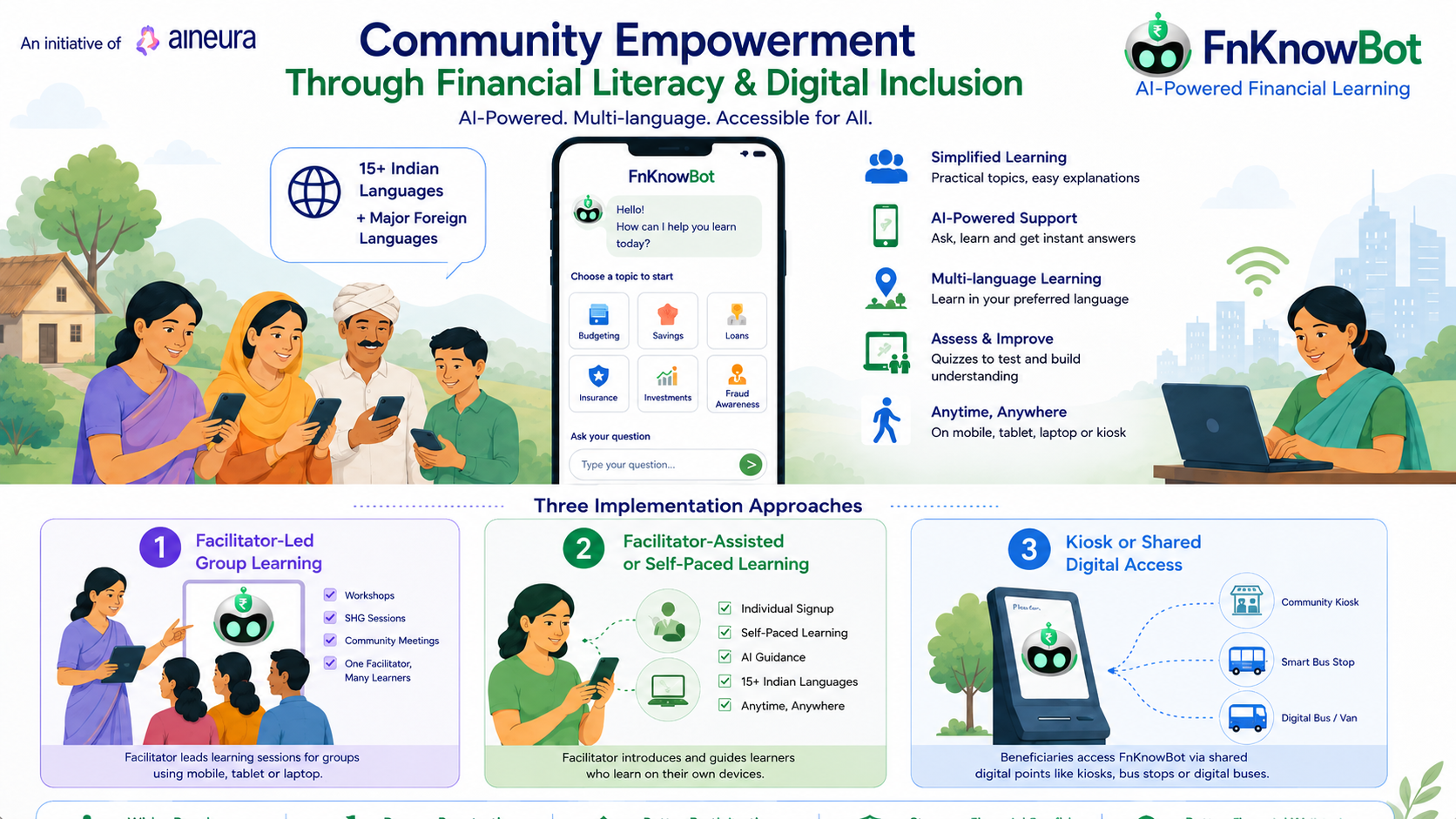
Community Empowerment Through Financial Literacy and Digital Inclusion: Three Ways FnKnowBot Can Reach the Grassroots
By: Amit R Charan , Founder, Aineura
Community-empowerment missions may work toward different objectives—women’s empowerment, livelihood development, entrepreneurship, youth skilling, rural inclusion, digital adoption or improved access to essential services.
Yet many of these missions depend on one common capability: people must understand how to manage money, evaluate financial choices and participate more confidently in economic life.
A livelihood programme may help someone begin earning, but the income must still be budgeted and managed. A women’s empowerment initiative may improve access to savings or credit, but participants must understand borrowing, repayment, insurance and financial risk. A youth-skilling programme may prepare learners for employment, but young earners also need to understand salaries, banking, taxation, debt and long-term savings.
Financial literacy can therefore become an enabling layer across multiple social-impact and community-development missions.
The challenge is to take this learning to diverse communities in a form that is affordable, multilingual, accessible, practical and capable of scaling without requiring continuous manual intervention at every location.
This is where FnKnowBot , Aineura’s AI-powered multilingual financial-learning platform, can support NGOs, non-profits, foundations, CSR initiatives, educational institutions and community organisations.
Financial Literacy as a Foundation for Community Empowerment
Community empowerment is not achieved merely by giving people access to money, technology, credit, employment or income-generating opportunities. People must also understand the responsibilities, risks and choices connected with those opportunities.
For example:
• Access to credit becomes more meaningful when a borrower understands interest, repayment obligations and over-borrowing risks.
• Income generation becomes more sustainable when earnings are supported by budgeting, savings and emergency planning.
• Digital payments become safer when users can recognise fraud, suspicious links, impersonation attempts and unauthorised requests.
• Insurance becomes more useful when families understand protection needs, exclusions, premiums and claims.
• Investing becomes more responsible when individuals understand suitability, diversification, market risk and long-term financial objectives.
The objective of financial learning is not to direct every learner toward a particular product or transaction. It is to help people build the knowledge and confidence required to ask better questions and make more informed decisions.
Digital Inclusion Must Go Beyond Providing Devices
Digital inclusion is often discussed in terms of internet connectivity, smartphones, computers, tablets and digital-service access.
These are important foundations, but access to a device does not automatically create understanding.
A digitally connected person may still struggle to:
• Find reliable and relevant financial information;
• Understand complex terminology;
• Identify the right questions to ask;
• Distinguish education from product promotion;
• Learn comfortably in English;
• Apply general information to everyday financial situations;
• Continue learning after a one-time workshop ends.
Meaningful digital inclusion should therefore help people use technology to learn, understand, participate and grow.
An AI-powered learning platform can help convert a digital device from a passive information-access tool into an interactive learning point.
How FnKnowBot Supports Financial Learning
FnKnowBot is designed to simplify personal finance learning through a combination of structured topics, guided questions and conversational AI support.
Learners can explore subjects such as:
• Budgeting and household money management;
• Savings and goal planning;
• Banking, loans and responsible credit use;
• Credit cards and debt management;
• Life, health and other forms of insurance;
• Investments and mutual funds;
• Stock-market and investing concepts;
• Retirement and long-term financial planning;
• Financial well-being;
• Digital payments and financial-fraud awareness.
Instead of leaving every learner to begin with an empty chatbot box, FnKnowBot provides pre-built questions organised under financial topics and subtopics.
A learner can select a question, read a simplified explanation, ask follow-up questions, explore related topics, prepare study notes and assess understanding through quizzes.
This guided structure is particularly relevant for new learners who may not know where to begin or may hesitate to frame their own questions.
Multilingual Learning for Wider Reach and Deeper Participation
Language can determine whether a learner merely sees information or genuinely understands it.
Financial subjects often contain unfamiliar terms. Even digitally confident users may struggle when explanations are available only in English or are filled with technical vocabulary.
FnKnowBot supports learning across more than 15 Indian languages, alongside major foreign languages. Learners can select a preferred language, explore structured financial topics and continue their queries in that language.
This multilingual capability can help community programmes:
• Reach beneficiaries across different states and regions;
• Reduce dependence on English-language content;
• Improve comfort and participation;
• Support facilitator-led learning in local languages;
• Enable beneficiaries to continue learning independently;
• Use one technology platform across multiple programme locations.
The purpose is not simply to translate words. It is to make financial concepts easier to understand in the language in which the learner feels most comfortable.
Three Implementation Approaches for Community Programmes
Different communities have different levels of device access, digital confidence, literacy and facilitator availability.
FnKnowBot can therefore be deployed through three broad implementation approaches. Organisations may select one approach or combine them according to their programme objectives and beneficiary profile.
1. Facilitator-Led Group Learning
In the facilitator-led model, a field worker, trainer, community volunteer or SHG leader conducts structured learning sessions for a group of beneficiaries.
The facilitator can access FnKnowBot through a mobile phone, tablet or laptop and use selected financial topics during workshops, community meetings, classroom sessions or self-help group gatherings.
The facilitator may:
• Select programme-relevant topics and questions;
• Explain AI-generated responses to the group;
• Encourage discussion around practical situations;
• Ask follow-up questions on behalf of participants;
• Conduct quizzes to assess understanding;
• Revisit concepts that require further clarification.
This model can be especially useful where beneficiaries:
• Have limited digital familiarity;
• Prefer learning in a group;
• Require assistance with reading or navigation;
• Participate through SHGs or community collectives;
• Do not individually own smartphones or internet-enabled devices.
One facilitator can guide multiple learners, allowing the organisation to extend financial learning across groups without requiring a separate subject-matter expert at every session.
The technology supports the facilitator; it does not remove the human connection that can be important in community learning.
Potential Use Cases
• Women and SHG financial-awareness sessions;
• Rural livelihood workshops;
• Youth-skilling programmes;
• Community financial-literacy camps;
• Digital-fraud awareness sessions;
• Entrepreneurship and small-business training;
• Financial well-being programmes for workers and communities.
2. Facilitator-Assisted or Self-Paced Learning
The second approach combines an initial human orientation with independent digital learning.
A facilitator introduces FnKnowBot, helps beneficiaries understand how to select topics, change languages, use pre-built questions and ask follow-up queries. Learners can then continue on their own mobile phones, tablets or laptops.
This model allows beneficiaries to:
• Learn at their own pace;
• Return to topics after a workshop;
• Ask questions privately without embarrassment;
• Explore subjects relevant to their individual circumstances;
• Learn in their preferred language;
• Continue beyond the organisation’s scheduled field sessions;
• Access the platform from home, work or another convenient location.
The facilitator remains available where assistance is required, but every learning interaction does not depend on the facilitator’s presence.
This can reduce repeated manual explanation while allowing the organisation to maintain a guided and supportive programme structure.
Why Self-Paced Learning Matters
Different learners have different financial concerns.
One participant may want to understand household budgeting. Another may need help understanding a loan. A young learner may be curious about investing, while a small entrepreneur may want to explore cash flow, borrowing and business-related risk.
Self-paced access enables each learner to follow a more relevant learning pathway instead of being restricted to one uniform session.
It also creates continuity. Financial literacy becomes an ongoing learning journey rather than a one-time awareness event.
3. Kiosks and Shared Digital Access Points
Some communities may have limited personal-device ownership or inconsistent internet access. In such locations, FnKnowBot can be deployed through shared digital access points.
These may include:
• Digital kiosks;
• NGO or community-centre computers;
• Shared tablets;
• Rural digital-learning centres;
• Educational institutions and libraries;
• Mobile digital vans;
• Smart bus stops equipped with digital screens or devices;
• Buses with embedded tablets or learning terminals;
• Public or sponsored digital-access points.
A shared access point can allow beneficiaries to use FnKnowBot even when they do not personally own a suitable device.
Depending on the programme, learning may be facilitator-supported or offered as walk-in, self-paced access.
For example, a community kiosk could provide selected financial-learning modules in regional languages. A digital bus could take learning to multiple villages or programme locations. A smart bus stop with an embedded learning device could turn waiting time into an opportunity for short, practical learning interactions.
This approach can expand the physical reach of a programme while maintaining a consistent digital learning experience across different locations.
Combining the Three Approaches
The three models need not operate separately.
A community programme could begin with facilitator-led orientation, provide shared access through a kiosk or community centre and enable digitally comfortable beneficiaries to continue learning on their personal devices.
A blended programme may follow this journey:
Step 1: The facilitator introduces the importance of financial literacy and demonstrates FnKnowBot.
Step 2: The group completes selected guided questions and quizzes.
Step 3: Beneficiaries receive assisted access on shared devices.
Step 4: Learners with personal devices continue independently.
Step 5: The organisation reviews engagement and identifies topics requiring additional field support.
This blended approach combines human guidance with the scalability and continuity of AI-assisted learning.
Supporting Wider Reach With Reduced Ground-Level Dependency
Traditional community-learning programmes often depend on repeated workshops, trainer availability, printed material, travel and continuous manual explanation.
These methods remain valuable, particularly for initial engagement and learners requiring assistance. However, digital and AI-supported learning can help organisations extend the value of their field efforts.
FnKnowBot can support wider reach and deeper programme penetration by enabling:
• One facilitator to guide multiple learners;
• Continued learning after field sessions end;
• Consistent access to structured explanations;
• Multiple-language delivery through one platform;
• Self-paced learning without constant trainer presence;
• Access across mobiles, tablets, laptops and shared devices;
• Reuse of the same learning infrastructure across locations;
• Faster addition of programme-relevant questions and topics.
The aim is not to eliminate ground-level engagement. It is to use technology so that every learner interaction does not require a new manual session.
This can help field teams focus their time on orientation, motivation, accessibility support, difficult questions and community relationships.
Supporting Multiple Empowerment Missions
Because financial understanding is relevant across different stages of economic life, FnKnowBot can complement several social-impact missions.
Women and SHG Empowerment
Learning can focus on household budgeting, personal savings, responsible borrowing, insurance, digital payments, fraud awareness and long-term financial independence.
Youth and Skill Development
Young people can learn about managing their first income, banking, budgeting, credit, insurance, financial fraud and the foundations of long-term savings and investing.
Livelihood Improvement
Beneficiaries can explore income management, emergency planning, responsible borrowing, insurance and financial resilience.
Entrepreneurship and Small-Business Support
Learning can include cash-flow awareness, separation of personal and business expenses, debt management, financial risk, insurance and prudent use of business income.
Rural and Underserved Communities
Multilingual and shared-device access can make structured financial learning available where trainers, educational resources or personal devices may be limited.
Digital-Inclusion Programmes
Beneficiaries can gain practical exposure to responsible AI-supported learning while also developing financial knowledge.
A Learning Layer for NGOs, Non-Profits and CSR Programmes
Most community organisations already have missions, beneficiary relationships, facilitators and implementation structures.
FnKnowBot need not replace these systems. It can operate as a financial-learning and digital-inclusion layer within an existing programme.
An organisation may align deployment with its programme by:
• Selecting relevant financial-learning modules;
• Adding beneficiary-specific guided questions;
• Choosing appropriate languages;
• Identifying the most suitable implementation model;
• Training facilitators to introduce the platform;
• Providing mobile, tablet, laptop or kiosk access;
• Using quizzes and engagement indicators to review participation.
This provides flexibility without requiring every organisation to build and maintain a separate financial-learning technology platform.
From Programme Reach to Learning Continuity
The impact of a learning programme should not be measured only by the number of workshops conducted or beneficiaries registered.
A digitally supported programme can also consider:
• Topics explored by learners;
• Frequency of engagement;
• Language preferences;
• Completion of selected learning pathways;
• Quiz participation and understanding;
• Common learner questions;
• Continued usage after facilitator-led sessions.
These indicators do not automatically establish behavioural or financial outcomes. However, they can help organisations understand whether beneficiaries are engaging with the learning resource and where additional support may be required.
Responsible AI With Human Support
AI can increase the reach, availability and responsiveness of financial learning, but responsible implementation remains essential.
FnKnowBot is an educational platform. Its learning content should not be treated as personalised financial, investment, legal or tax advice. Individual decisions may require consultation with qualified professionals or authorised institutions.
Human facilitators also remain important for learners with limited literacy, low digital confidence, accessibility requirements or complex personal situations.
The stronger model is therefore not AI replacing people. It is AI supporting people—helping facilitators extend their reach and enabling learners to continue independently.
The Larger Vision
Community empowerment requires more than one-time access to information. It requires learning that people can understand, revisit and use.
By combining financial literacy, multilingual learning, mobile accessibility and conversational AI, FnKnowBot can help organisations take practical financial education closer to the grassroots.
Its three implementation approaches—facilitator-led group learning, facilitator-assisted or self-paced access, and learning through shared digital points—allow programmes to adapt the technology to different communities and infrastructure conditions.
The larger opportunity is to turn existing mobiles, tablets, laptops, kiosks, community centres, smart public spaces and mobile outreach infrastructure into accessible points of financial learning.
In doing so, NGOs, non-profits, foundations and CSR initiatives can extend learning beyond a workshop, reach more beneficiaries across languages and locations, and support deeper, more continuous participation with reduced dependence on repeated manual delivery.
Explore simplified multilingual financial learning with FnKnowBot .
For institutional and social-impact collaborations:
WhatsApp:
+91.9266877036
Email:
contact@fnknowbot.in
About the Author: Amit R Charan is the Founder of Aineura , an author, and a corporate lawyer. At Aineura, he is building FnKnowBot as a comprehensive personal finance learning platform leveraging AI to make financial literacy simplified, accessible, interesting and impactful—for sustainable social impact in India and beyond.