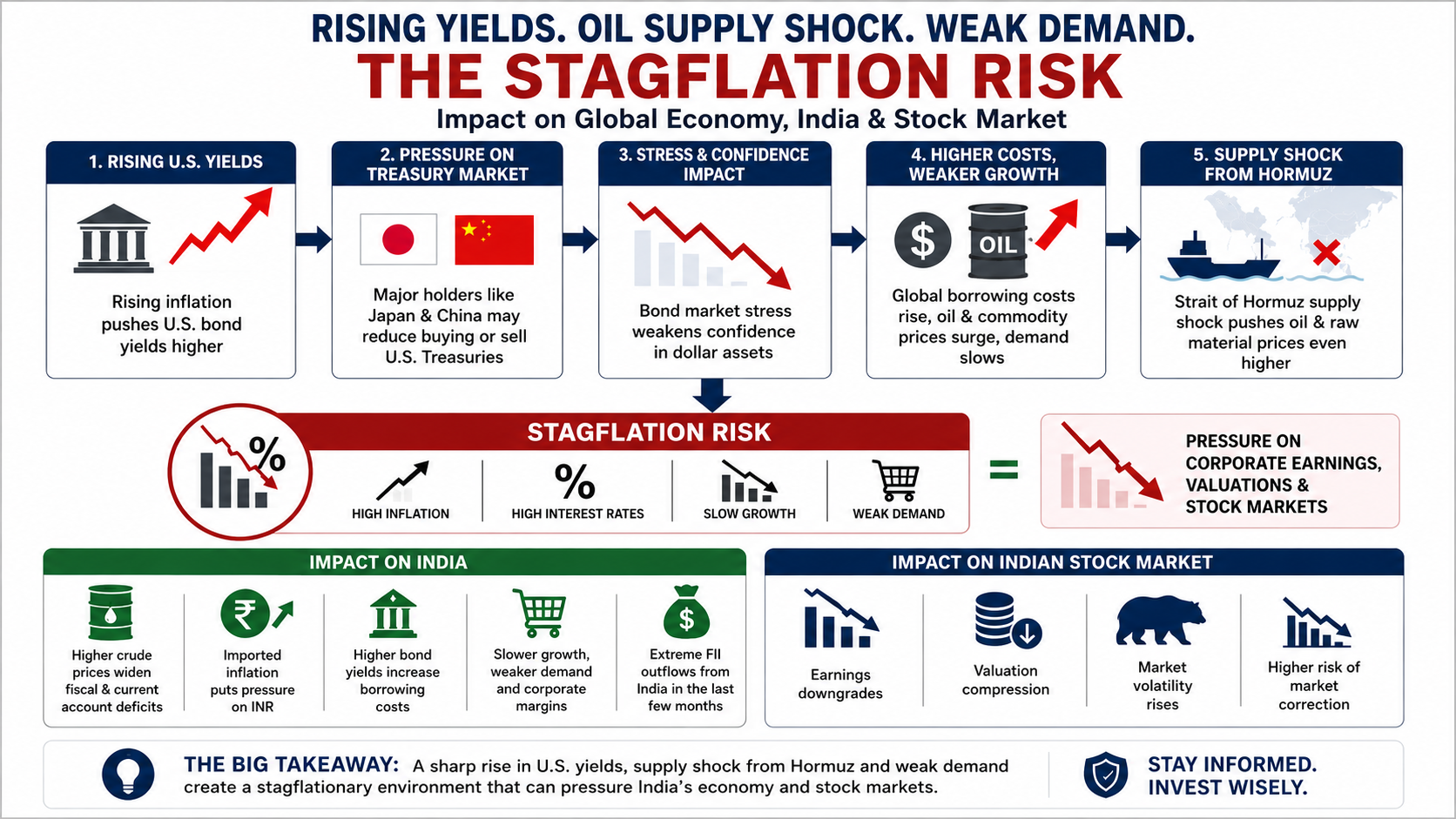
𝐒𝐭𝐚𝐠𝐟𝐥𝐚𝐭𝐢𝐨𝐧 𝐑𝐢𝐬𝐤: 𝐖𝐡𝐲 𝐁𝐨𝐧𝐝 𝐘𝐢𝐞𝐥𝐝𝐬, 𝐎𝐢𝐥 𝐏𝐫𝐢𝐜𝐞𝐬 𝐚𝐧𝐝 𝐅𝐈𝐈 𝐎𝐮𝐭𝐟𝐥𝐨𝐰𝐬 𝐌𝐚𝐭𝐭𝐞𝐫
By: Amit R Charan
Global markets are watching a difficult macro-economic combination: elevated U.S. bond yields, oil supply risks linked to the Strait of Hormuz, heavy FII/FPI outflows from India, and signs of weakening global demand.
Individually, each of these factors can create market pressure. Together, they may point toward a more uncomfortable risk: 𝐬𝐭𝐚𝐠𝐟𝐥𝐚𝐭𝐢𝐨𝐧.
Stagflation is a situation where inflation remains high while economic growth slows. It is challenging because economies face pressure from both sides — rising costs on one side and weaker demand on the other.
📈 𝐖𝐡𝐲 𝐇𝐢𝐠𝐡𝐞𝐫 𝐔.𝐒. 𝐁𝐨𝐧𝐝 𝐘𝐢𝐞𝐥𝐝𝐬 𝐌𝐚𝐭𝐭𝐞𝐫
When U.S. bond yields remain high or rise further, global capital becomes more cautious. Investors often reassess risk, especially in emerging markets.
Higher global yields can lead to:
• Higher borrowing costs;
• Stress in bond markets;
• Reduced appetite for risky assets;
• Pressure on emerging market currencies;
• Capital outflows from equity and debt markets.
For countries like India, this can create pressure on the Rupee, increase external financing concerns, and affect current account dynamics, especially when oil prices are also elevated.
🛢️ 𝐎𝐢𝐥 𝐒𝐮𝐩𝐩𝐥𝐲 𝐑𝐢𝐬𝐤 𝐚𝐧𝐝 𝐭𝐡𝐞 𝐇𝐨𝐫𝐦𝐮𝐳 𝐅𝐚𝐜𝐭𝐨𝐫
The Strait of Hormuz is one of the world’s most important energy transit routes. Any disruption or fear of disruption can quickly affect crude oil prices and market sentiment.
Higher crude oil prices can increase:
• Fuel costs;
• Transport expenses;
• Raw material prices;
• Food inflation;
• Input costs for companies.
For India, this risk is especially important because the country depends heavily on crude oil imports. When crude becomes expensive, imported inflation can rise, corporate margins can come under pressure, and household consumption can weaken.
💸 𝐅𝐈𝐈 𝐎𝐮𝐭𝐟𝐥𝐨𝐰𝐬 𝐚𝐧𝐝 𝐏𝐫𝐞𝐬𝐬𝐮𝐫𝐞 𝐨𝐧 𝐈𝐧𝐝𝐢𝐚𝐧 𝐌𝐚𝐫𝐤𝐞𝐭𝐬
Foreign Institutional Investor outflows can add another layer of pressure. When global investors reduce exposure to Indian equities or debt, it can affect market liquidity, investor confidence, and currency stability.
Persistent FII selling may lead to:
• Market volatility;
• Pressure on equity valuations;
• Weakness in the Rupee;
• Higher sensitivity to global risk-off sentiment;
• Greater dependence on domestic investor support.
This does not mean markets must fall sharply. But it does mean the margin of safety becomes narrower when global liquidity tightens, crude prices rise, and growth expectations weaken at the same time.
📉 𝐖𝐞𝐚𝐤𝐞𝐧𝐢𝐧𝐠 𝐆𝐥𝐨𝐛𝐚𝐥 𝐃𝐞𝐦𝐚𝐧𝐝 𝐀𝐝𝐝𝐬 𝐭𝐨 𝐭𝐡𝐞 𝐑𝐢𝐬𝐤
The stagflation concern becomes more serious when inflationary pressures are accompanied by slowing demand.
If global demand weakens, export growth, corporate earnings, manufacturing activity, and investment sentiment can all face pressure. At the same time, if oil prices and borrowing costs remain high, companies may face rising costs even as demand slows.
That is the difficult part of stagflation: businesses face cost pressure, consumers face price pressure, and markets face earnings pressure.
📊 𝐏𝐨𝐬𝐬𝐢𝐛𝐥𝐞 𝐈𝐦𝐩𝐚𝐜𝐭 𝐨𝐧 𝐒𝐭𝐨𝐜𝐤 𝐌𝐚𝐫𝐤𝐞𝐭𝐬
For stock markets, stagflation risk can be uncomfortable because it affects both earnings and valuations.
The possible market impact may include:
• Earnings pressure due to higher input costs;
• Valuation compression due to higher yields;
• Increased volatility due to global uncertainty;
• Sector rotation toward defensives;
• Correction risk in overvalued or highly leveraged segments.
Companies with strong balance sheets, pricing power, lower debt, and resilient demand may be better placed than companies that depend heavily on cheap capital, imported inputs, or discretionary spending.
⚠️ 𝐓𝐡𝐞 𝐑𝐞𝐚𝐥 𝐂𝐨𝐧𝐜𝐞𝐫𝐧: 𝐈𝐧𝐟𝐥𝐚𝐭𝐢𝐨𝐧 𝐏𝐥𝐮𝐬 𝐒𝐥𝐨𝐰𝐢𝐧𝐠 𝐆𝐫𝐨𝐰𝐭𝐡
The concern today is not just inflation. Inflation alone can be addressed through policy tightening, supply normalization, or demand adjustment.
The bigger concern is inflation plus slowing growth. When both appear together, policy choices become harder. Central banks may hesitate to cut rates if inflation is high, while governments may face pressure to support growth without worsening fiscal stress.
For investors, this means macro awareness becomes important. It is not enough to look only at stock prices. One must also understand crude oil, bond yields, currency movements, capital flows, inflation, and demand trends.
🌱 𝐖𝐡𝐲 𝐅𝐢𝐧𝐚𝐧𝐜𝐢𝐚𝐥 𝐋𝐞𝐚𝐫𝐧𝐢𝐧𝐠 𝐌𝐚𝐭𝐭𝐞𝐫𝐬 𝐢𝐧 𝐒𝐮𝐜𝐡 𝐓𝐢𝐦𝐞𝐬
In uncertain macro conditions, financial literacy becomes more important. Investors and learners need to understand how different parts of the economy connect with each other.
Oil prices affect inflation. Bond yields affect valuations. Currency weakness affects imports. FII outflows affect market sentiment. Slowing demand affects earnings.
Understanding these linkages helps people avoid panic, think more clearly, and make better-informed financial decisions.
🤖 𝐖𝐡𝐞𝐫𝐞 𝐅𝐧𝐊𝐧𝐨𝐰𝐁𝐨𝐭 𝐂𝐚𝐧 𝐇𝐞𝐥𝐩
This is where accessible financial learning becomes useful. FnKnowBot, developed by Aineura, is an AI-powered financial learning assistant that helps users understand personal finance, investing concepts, macro-economic terms, market risks, and everyday money decisions in a simpler way.
Through guided questions, simplified explanations, multilingual support, country-specific insights, and practical learning assistance, FnKnowBot can help learners build a clearer understanding of financial topics without being overwhelmed by jargon.
In a market environment where inflation, bond yields, oil prices, FII flows, currency movements, and growth expectations are all connected, better understanding can become a real advantage.
Explore simplified financial learning with FnKnowBot.
About the Author: Amit R Charan is the Founder of Aineura, an author, and a corporate lawyer. At Aineura, he is building FnKnowBot as a comprehensive personal finance learning platform leveraging AI to make financial literacy simplified, accessible, interesting, and impactful — for sustainable social impact in India and beyond.